Skip to content
Topic15 entries

Maintenance

Build and follow a reliable maintenance plan: time- and mileage-based intervals, fluids, filters, belts, brakes, batteries, and care under severe or short-trip use.

  1. Updated August 24, 202611 min read

    Engine Oil Intervals and Specifications: Find the Rule for Your Exact Car

    There's no generic answer to how often to change oil or which oil to use. This guide shows how to match your exact vehicle to the right manufacturer documents, separate the service interval from the full oil requirement, and record both — along with your service history — in one usable form.
  2. Updated August 24, 202610 min read

    How to Read a Manufacturer Maintenance Schedule

    Learn how to identify the manufacturer maintenance schedule that applies to your specific car, read an entry as a connected set of action, trigger, conditions, notes, and exclusions, and record what's done, due, not yet applicable, or unknown — without treating paperwork as proof of the car's present condition.

  3. Updated August 24, 202614 min read

    Maintenance for Low-Mileage and Short-Trip Cars: Build a Per-Item Plan

    A method for owners of low-mileage or mostly-short-trip cars to turn the exact manufacturer schedule and whatever records they have into a per-item plan, with separate time and distance due points and a place to keep unresolved evidence visible instead of guessed at.

  4. Updated August 23, 202610 min read

    How to Build a Car Maintenance Plan From Incomplete Records

    A source-first method for sorting car maintenance information into documented work, schedule-due work, unresolved history, and urgent assessment, with a copyable organiser and a worked hypothetical example.

  5. Updated August 20, 202611 min read

    Car filter types: how to find the right replacement intervals

    Engine-oil, engine-air, cabin-air and fuel filters do different jobs, but whether your car has each one, whether it's a separate service item, and when it needs attention depends on the exact manufacturer documentation for your model year, powertrain, configuration and market. This guide explains the categories, compares a generic interval with checking the real document, and gives a compact method for recording what applies to your car.

  6. Updated August 20, 202615 min read

    How to Plan a 12-Volt Battery Replacement Without Guessing

    Plan a 12-volt or other conventional low-voltage-battery replacement from your exact vehicle's requirements, recorded observations, and suitable assessment evidence — not from battery age, a warning label, or one voltage value alone. Covers combustion, hybrid, plug-in-hybrid, and electric cars as users of the same planning framework, with a three-path decision aid, worked hypothetical cases, and a compact verification list.

  7. Updated August 20, 202612 min read

    Timing Belts, Wet Belts and Timing Chains: How to Identify What Your Car Has

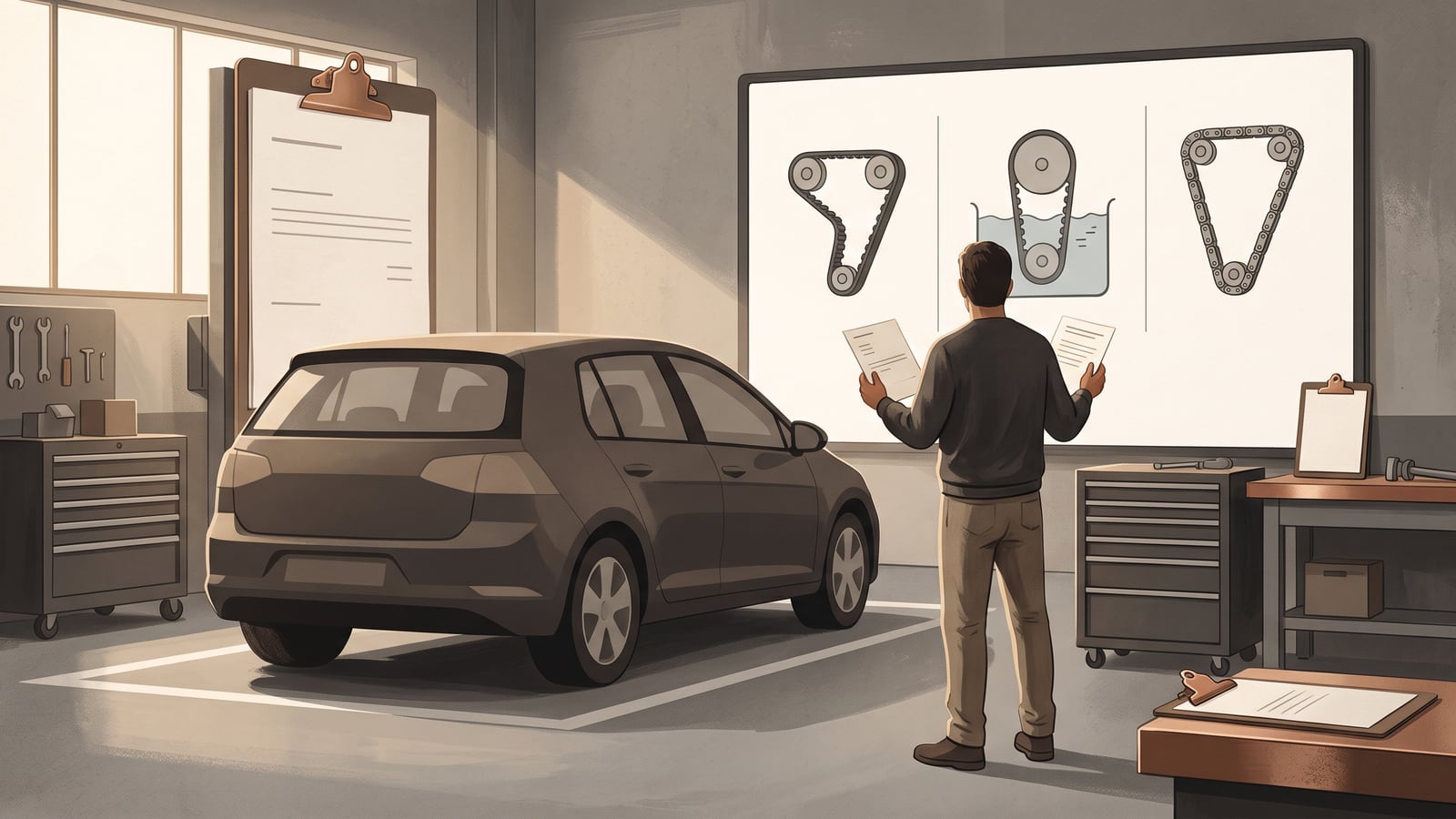
    Conventional timing belts, belt-in-oil (wet-belt) designs, and timing chains are different constructions with different planning implications, but none of the three labels tells you what your specific car needs. This guide walks through identifying the vehicle, engine, and applicable manufacturer document, then gives you a copyable record and a set of workshop questions — without asking you to inspect, diagnose, or repair anything yourself.

  8. Updated August 18, 202610 min read

    Does Changed Car Use Change Your Maintenance Schedule?

    When your regular driving pattern is about to change, the right response is to check the exact manufacturer document for your vehicle, market, model year and powertrain — not to assume a shorter interval. This guide walks through the three possible outcomes, a copyable update note, and worked examples showing how changed use can land differently depending on the document.

  9. Updated August 15, 20269 min read

    Time-Based vs Mileage-Based Maintenance: Which Clock Governs?

    Mileage alone can't tell you when a maintenance item is due. This guide explains the four trigger structures manufacturers use, shows bounded examples of how they appear in real schedules, and gives a fill-in template for comparing one item's trigger against your documented history.

  10. Updated August 15, 20267 min read

    What "Severe Operating Conditions" Mean in Your Car's Maintenance Schedule

    A short method for reading the 'severe' or 'special' operating-conditions section of a car maintenance schedule: copy the condition, the affected item, and the linked instruction, then use a compact template to ask a manufacturer representative or workshop which instruction governs.

  11. Updated August 10, 202611 min read

    Build a Maintenance Baseline After Buying a Used Car

    A used-car owner with mixed and incomplete records can sort what they have into four categories — confirmed by evidence, history still unknown, current observations, and next questions — and use that record to compare against exact vehicle information and prepare a workshop visit, without turning missing paperwork into assumed neglect or an observation into a diagnosis.