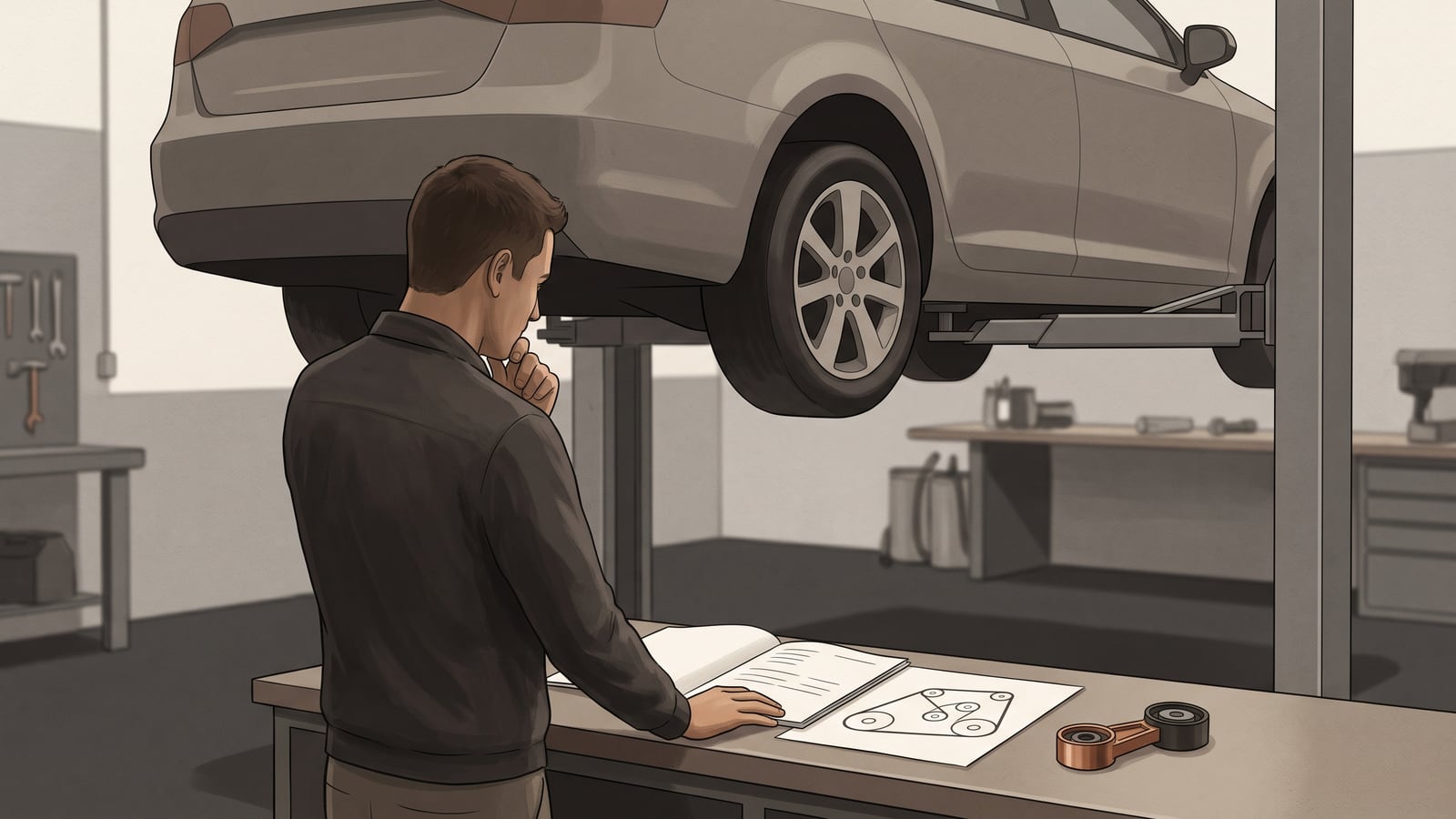
Don't pick a service interval, guess at a fault, or approve belt-related work just because a form says "auxiliary belt." That phrase alone doesn't tell you what needs doing.
Manufacturers use several names for belt drives on a car: auxiliary, accessory, serpentine, water-pump, and timing. These terms can point to different systems, and which one applies, and what components it involves, depends on the exact vehicle, engine or powertrain, model year, and market — a Hyundai document and a Volvo document can list the same-sounding items very differently, and neither proves a universal layout. So before you read a service record or trust a quote, the useful first move is working out exactly which system your car has and which document governs it.
This guide walks you through that: telling a timing drive apart from an auxiliary or accessory drive, what a belt system might include, how to describe a concern to a workshop without diagnosing it yourself, and a compact way to prepare before you call.
Identify the drive first
A timing drive keeps the engine's internal moving parts working in sync with each other — the valves opening and closing at the right moment relative to the pistons. An auxiliary or accessory drive is different: it may run equipment mounted on the outside of the engine, like the alternator, power steering pump, or air conditioning compressor. Not every engine has both kinds of belt, and not every auxiliary drive powers the same equipment. What's fitted, and what it's called in the paperwork, is specific to your car.
Two scoped examples
Two manufacturer documents show the point without settling it for every car.
The 2025 Hyundai Tucson's published maintenance schedules list drive-belt items separately from certain timing-belt items, and the drive-belt entries include hardware such as the tensioner, an idler, and the alternator pulley. One thing worth flagging: the version of the schedule used outside Europe changes a named instruction compared with the European version — same model, different market, different wording.
Volvo's 2018 US/Canada maintenance table for its non-hybrid models takes a similar shape: one row covers the accessory belt, tensioner, and idler pulley, and a separate row covers timing-drive service, within the engines that document covers.
Both examples follow the same pattern: the drive-belt and timing-drive items sit in separate entries, but the exact wording, the hardware named, and even the interval can shift between markets and model years for the same manufacturer. That's why you check your own documentation rather than borrow someone else's schedule.
What the system may include
Beyond the belt itself, a workshop assessing a belt system may need to look at the tensioner (the part that keeps the belt under the right amount of pressure), idler pulleys (which guide the belt but don't power anything), other pulleys, and whatever components the belt turns. Which of these apply, and how many, depends on the vehicle in front of the workshop.
One documented example makes this concrete without turning into a universal picture. Toyota's technical description of its 2AZ-FE engine's serpentine belt system — a "serpentine" belt is a single continuous belt that winds around several pulleys rather than several separate belts — lists a handful of driven components, an idler, and an automatic tensioner that uses spring force to keep tension on the belt. That's one design, on one specific engine, documented as a historical technical reference, not a blueprint for how every car's belt system works.
The takeaway isn't a parts list to memorize. It's that "the belt job" can reasonably cover several components beyond the belt strip itself, and only the applicable manufacturer instruction and a qualified assessment can say which ones apply to your car.
Keep the physical check out of scope
Before the checklist, it's worth being clear about where your involvement stops. Everything in this guide keeps you at the level of paperwork, record-gathering, and any stationary observation your manual expressly allows — nothing here covers reaching into the belt area, inspecting with the engine running, routing or tensioning a belt, replacing one, or working under the car; those steps belong to a qualified workshop.
That boundary isn't arbitrary. Hyundai's instruction for the 2026 LX3HEV's water-pump belt inspection requires the engine to be off and hands and clothing kept clear during the check. Ford's 2021 Courier manual warns against working on a hot engine and notes the cooling fan can keep running after the engine is switched off. Neither warning applies to every engine — they're specific to those documents — but together they explain why this guide never asks you to open the bonnet and look at a moving or hot part yourself. If a question can only be answered by watching the belt move or looking up close, that question goes to the workshop, guided by your car's own manual.
Build the workshop handoff
Once you know that the system, its components, and the governing document are all specific to your car, the next step is turning that into something you can hand over. Use the checklist below to prepare for your own car, or read the worked example after it to see how the fields play out.
Copyable preparation checklist
What follows is a documentation-first planning framework put together for this guide, not a manufacturer-issued procedure — the actual scope of any work still depends on the applicable manufacturer instruction and a qualified assessment. Copy it, fill in what you know, and leave the rest blank rather than guessing.
- Vehicle identity: make, model, model year, engine or powertrain, and market — plus the VIN where it helps confirm the rest.
- Governing document: the current owner's manual or manufacturer maintenance reference for that exact identity, not a generic version.
- Service history: dated entries copied in their exact wording, plus an explicit note of any period with no record at all.
- Observed concern: what you noticed, when it happens (cold start, under load, at speed), and any warning light shown — described, not diagnosed.
- Stationary observations: anything your exact manual expressly tells you that you're allowed to check without the engine running.
- Request to the workshop: ask them to identify the fitted drive and the manufacturer instruction that applies to it.
- Scope questions: ask whether their proposed work considers the belt, the tensioner, idlers or pulleys, and the components the belt turns — where those apply to your car.
- Reminder for both of you: the applicable manufacturer instruction and the qualified workshop's own assessment are what actually determine the work that's due — this framework only prepares the conversation.
Completed example: clarification needed
Here's how that looks filled in, for a hypothetical twelve-year-old passenger car with gaps in its history. This is illustrative only — no specific make, engine, market, or manual is implied.
- Vehicle identity: model year and VIN are known. Make and model are known too, but engine/powertrain and original market haven't been confirmed yet.
- Governing document: not yet found — that depends on confirming engine and market first.
- Service history: one dated entry from six years ago, worded vaguely; nothing at all before or after it.
- Observed concern: a faint chirping sound on cold starts only, gone within a minute. No warning light. No cause assigned.
- Stationary observations: none attempted — the applicable manual hasn't been identified yet.
- Request to the workshop: confirm which drive is fitted and point to the manufacturer instruction that covers this exact vehicle.
- Scope questions: asked but not yet answerable — they depend on what the workshop finds.
The honest result here is clarification needed, not a definite interval, fault, or green light. That's a legitimate outcome, not a failure of the exercise.
Say the workshop confirms the engine, the market, and the applicable document in a follow-up call. The next decision still isn't automatic. If that one dated entry turns out to describe work matching the confirmed system and instruction closely enough, the owner can compare it against what's now known to be due. If it doesn't — if the wording is still too vague to tell — the bounded next step is to weigh the workshop's proposed inspection or service, rather than assuming the car is either covered or overdue.
Describe concerns without diagnosing
When you notice a sound, a warning light, or anything else, write down what happened and when, not what you think it means. "A chirping sound on cold starts, gone after about a minute" is useful. "The tensioner is going" is a guess dressed up as a fact, and it can send a workshop chasing the wrong thing.
The same caution applies to any manual-permitted check: keep clear of moving or hot components and follow the exact current manual for anything beyond looking.
An observation like this, or a service record on its own, doesn't diagnose anything, doesn't establish how urgent the situation is, and can't certify that the car is safe or roadworthy — those depend on the applicable manual and a qualified assessment. Your job at this stage is to give the workshop good raw material, not a conclusion.
Choose the history path
How you proceed next depends heavily on what your records show.
| Quality of evidence | Immediate planning move | Main limitation | |
|---|---|---|---|
| Documented history | Dated entries with specific wording | Compare the record against the applicable instruction | Wording may still be too vague to pin down the exact drive |
| Uncertain history | Gaps, or no records at all | Ask the workshop to confirm what's fitted before proposing scope | Absence proves neither that work was done nor that it's overdue |
When records are specific
This path suits an owner whose service history names dates and describes the work clearly enough to mean something. Its advantage: you're not starting from zero. Its limit: even a dated invoice can be ambiguous, and having something recorded doesn't tell you the car's current condition.
Take a hypothetical case: an entry simply reads "belt checked," dated some years back. The owner copies the date and the exact wording, confirms the vehicle identity fields, and asks the workshop which fitted system that entry could plausibly refer to. Until that's answered, the record stays ambiguous — useful, but not proof of anything. Compare that to an owner with no record at all, who has to establish which system even applies before they can ask a meaningful question about a specific job.
When history is uncertain
This path suits a used-car owner who genuinely can't tell from the paperwork what belt-related work, if any, has been done. Its advantage: it keeps the unknown honest instead of assuming either extreme. Its tradeoff: missing history proves neither completion nor neglect, and it likely means the workshop needs to identify the system and assess it before anyone can talk about scope.
Picture an owner who has the VIN and model year but hasn't confirmed the engine or the car's original market yet, with no history at all from before they owned it. The temptation is to reach for a generic interval or peer at the belt themselves to form an opinion. Neither is a safe substitute. The bounded, useful move is to get the applicability questions answered first — engine, market, fitted system, applicable document — and let that determine what happens next.
If cost enters the decision
If you're weighing cost at this stage, the only workable number is a current, itemised quote from a workshop for your specific car, once the fitted system and proposed scope have been identified. There's no generic price, average, or labour-time figure that means anything here — those depend on the vehicle and the work found to be needed. And cost can't answer the earlier question either: it won't tell you which system is fitted, and it can't tell you whether the car is safe to drive.
Where to go next
This article sits in Autonelio's maintenance section, alongside guides on confirming exactly which car you're dealing with before you rely on any schedule (how to identify a car correctly), on reading the manufacturer's own maintenance table once you've found it (how to read a manufacturer maintenance schedule), and on turning scattered records into something usable rather than something you mistake for proof (how to organise car service records). From there, the wider car ownership section covers the rest of what owning and maintaining a car well involves.
Your next step: locate the exact current owner or maintenance manual using the vehicle, model year, engine or powertrain, and market, then place it beside the dated service records before contacting a qualified workshop.