The label is only the start
Someone tells you your car has a timing belt. Or a wet belt. Or a chain. None of those words tells you what to do next.
Here's the short version: don't pick a service interval, and don't assume anything about the part's condition, just because you've heard one of those words. The word is a category, not a plan.
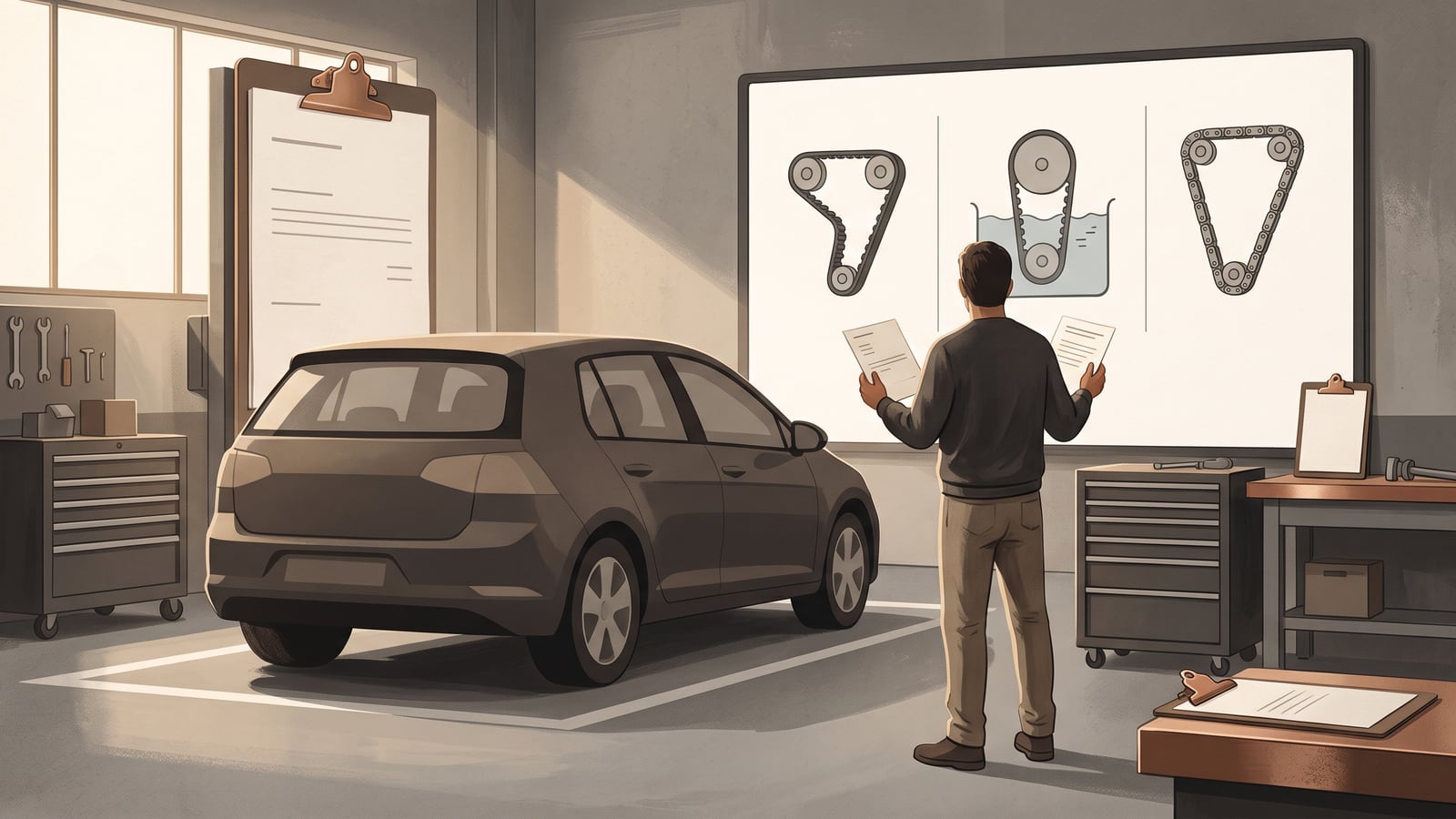
A little context helps the rest make sense. The timing drive connects the crankshaft's rotation to the camshafts, so the valves open and close in step with the pistons. Get that timing wrong and the engine's basic four-stroke sequence stops lining up. That's the job, however it's built.
Three labels come up most often when people describe how that job gets done: a conventional timing belt, a belt-in-oil design (often called a wet belt), and a timing chain. One components manufacturer, Continental, describes its own conventional-belt construction and, separately, the belt-in-oil systems it engineers for oil-bath operation. A parts kit from another manufacturer, INA, shows that one specific chain-drive application bundles in more than the chain itself — a tensioner, guides, and gears among the extras. Those are useful pictures of what each category can look like — not a catalogue of how every belt or chain on the road is built.
Each category carries real, different planning implications. But working out which one your car has, and what it needs, comes from current manufacturer information for your exact vehicle. A seller's word, a badge, or a patchy service history is a clue worth chasing, not an answer to file away.
What each design changes
These sources don't establish a single lifespan figure for any of the three designs. Weighing conventional belts, belt-in-oil designs, and chains against each other is a planning exercise, not a ranking — what suits your planning depends on the exact application and the records behind it, and there's no universal winner among the three, nor a reason to pick a car by which one it has.
| Dimension | Conventional belt | Belt-in-oil | Chain |
|---|---|---|---|
| What the label establishes | A toothed belt, in a category Continental describes for its own products | A timing belt built to run in an oil bath, in the applications Continental discusses | Part of a wider drive system — the chain plus, in some applications, tensioners, guides, gears, and seals |
| What you still need to verify | Whether your engine and manual specify a schedule for this belt | Whether your engine and manual confirm this design, and which oil specification applies | Whether your exact engine and any applicable service information cover your car |
| Records that matter | Manufacturer document, engine match, any prior belt work with date and mileage | Same, plus the exact approved oil specification on record | Manufacturer document, engine match, any prior drive-system work |
| What stays unknown without assessment | Present condition, remaining life | Present condition, remaining life, and whether the correct oil has been used | Present condition of the chain and its associated components |
Once your manual confirms which type you have, you know where to focus:
- Conventional belt: the applicable schedule, plus whatever belt work is already on record.
- Belt-in-oil (wet belt): the same, plus the exact oil specification on file.
- Chain: whatever vehicle-specific information exists about the drive system as a whole.
Conventional timing belt
It's a toothed belt, built to hold precise timing. Continental describes its own conventional-belt construction as fabric, an elastomer body, and tension members, sometimes with a fabric backing — that's an attributed description of Continental's products, not a claim that every timing belt on the market is built the same way.
Where this category is genuinely useful: your manufacturer's schedule may state an engine-specific belt replacement point, and once you've confirmed the exact engine match, that becomes a real planning anchor. Where it falls short: an interval borrowed from a different engine, market, or manual edition doesn't fill a gap in your own vehicle's record — it just looks like an answer. This category is a poor fit for planning if you don't yet know your exact engine, or if the only schedule you've found belongs to a different market or document revision than the one covering your car.
Belt running in oil
A belt-in-oil design is still a timing belt in construction, but it's meant to run inside the engine, submerged in oil. Continental discusses this construction for the applications it covers — again, a description of specific products and applications, not a statement that every wet-belt system on the market is identical.
The planning implication that matters most: once you've confirmed this design on your car, the exact manufacturer-approved oil specification becomes part of what you record and ask about. A viscosity grade by itself — 5W-30, for instance — isn't the same thing as the full approved specification a wet-belt system may call for, and the two shouldn't be treated as interchangeable. Once the application is confirmed, recording the precise specification gives any future workshop conversation something concrete to check against. This category can't support a claim about how long a wet belt lasts or how reliable it is — the sources describe construction and application, not a lifespan verdict. This design is a poor fit for planning if you only have a generic oil grade, a seller's description, or a schedule that doesn't clearly confirm the application.
Timing chain
A chain belongs to a wider system, not just itself. The scoped INA kit for one named application demonstrates that a chain drive can include a tensioner, guides, gears, phasing components, and seals alongside the chain — that's what one specific kit for one specific application contains, not a description of every timing-chain system.
That matters because the conversation worth having with a workshop is often about the whole drive system, not the chain by itself. The sources behind this guide don't support a general condition or maintenance conclusion for chains either way, so neither a model's reputation nor the bare word "chain" on a spec sheet should stand in for checking whether applicable manufacturer information exists for your exact engine. On that note: one manufacturer's technical bulletin about a metallic chain-drive noise applies only to named applications and specific engine codes, and it exists to guide a workshop's diagnosis, not to hand you an owner's rule for what a noise means. This category is a poor fit for planning if your only evidence is model reputation or ambiguous listing text, or if you can't yet match the engine code to whatever information exists.
Match the application
Here's the part that actually does the work: any schedule, specification, or bulletin you find is only good for the exact vehicle and engine application, the applicable market, and the specific document revision it was written for — don't transfer a requirement from one application to another just because the engine or model name looks similar.
A compact US-market example makes this concrete. Ford publishes different online owner's-manual variants, and they don't say the same thing. One variant, numbered 4724, shows different distances for its specified 1.0-litre engine and its specified 1.5-litre engine — not one figure covering both. A separate variant, numbered 3324, gives a time-or-distance requirement for named belts on its specified 1.0-litre engine and a different distance for its specified 1.6-litre engine. These are figures shown by the source for that exact manual variant and specified engine; they demonstrate how much a requirement can differ between two engines and two document revisions, not a number to copy onto your own car. Ford itself warns that the online version of a manual can differ from the printed manual that originally came with a specific vehicle, and treats that original printed manual as the primary reference for that vehicle.
The same logic applies to component-level service information. INA's bulletin about a chain-drive noise is written for named diesel applications and specific engine codes from one manufacturer's range, and it defers to that vehicle manufacturer's own specifications rather than standing on its own. If your engine code isn't on that list, the bulletin doesn't apply — it's not evidence either way about your engine.
Build your timing-drive record
Everything above narrows down to one job: matching your car to the document that governs it. This article can get you to that document and help you record what it says — the current manufacturer information for your exact vehicle decides the schedule and any oil specification, and physical identification or condition assessment is a job for a qualified workshop, not something to attempt yourself.
- Record your registration or VIN, plus make, model, model year, and market. Add the exact engine or engine code if you can find it.
- Find the current manufacturer handbook, service schedule, or applicable service information for that exact vehicle.
- Note the document's title, its version or date if shown, and the date you checked it.
- Record the timing-drive type only if the matched document states it. If you can't match the source to your exact vehicle, leave that field as unknown — don't guess.
- Add any documented prior timing-drive work, with its date and mileage, and list whatever questions remain for a qualified workshop.
Here's a blank version of that record you can copy:
Registration/VIN:
Make / model / model year / market:
Exact engine or engine code:
Timing-drive type: [ ] Conventional belt  [ ] Belt-in-oil  [ ] Chain  [ ] Unknown
  Supporting source (or "unknown"):
Manufacturer document title:
Document version/date:
Date checked:
Prior timing-drive work (date, mileage):
Open questions for the workshop:
And here's what an honest, incomplete version of that record looks like in practice — this is hypothetical, not a real vehicle:
Manufacturer document: Ford online Owner's Manual variant 3324; market: USA; exact vehicle/engine match: not established; timing-drive type: unknown; next decision: confirm the engine application before using the schedule.
Notice what that record doesn't do. It doesn't guess a drive type from the model name. It doesn't borrow a figure from a manual variant that hasn't been confirmed as the right one. It states the one thing that's missing — a confirmed engine match — as the next thing to resolve.
Three situations where the answer stays bounded
These are hypothetical owners, not case studies. Each shows how the same evidence discipline plays out under an everyday constraint.
Incomplete history. A hypothetical used-car owner has a receipt that just says "timing belt" — no engine code, no source, no date, no mileage. That wording could describe a conventional belt or a belt-in-oil design; it doesn't distinguish between them, and it can't rule out the receipt simply being wrong or referring to a different part. A chain reputation attached to the model name doesn't settle anything either — it's not evidence about this specific car. The owner records the receipt as incomplete, leaves the drive-type field unknown, and the bounded next decision is to ask a workshop to match the exact engine application before any maintenance planning happens. What this can't establish: the belt's condition, its true age, or whether it was ever replaced.
A multi-year ownership plan. A hypothetical owner plans to keep an eleven-year-old hatchback for at least five more years. The only evidence on hand is a used-car dealer's checklist that says "timing belt replaced," with no date, mileage, or document reference, plus the registration and engine code taken from the vehicle's own documents. That's enough to start a proper search: the owner uses the registration and engine code to look up the manufacturer's current schedule for that engine. If the schedule confirms a conventional belt, the next records to gather are the schedule's stated requirement and any dated invoice matching the dealer's note. If it confirms a belt-in-oil design instead, the exact oil specification joins that same search. If it confirms a chain, the owner instead looks for vehicle-specific information about the wider drive system. Until the manufacturer document is matched to the exact engine, none of that is resolved. On its own, the dealer's checklist entry can't establish which design is fitted, when the work was done, or whether it happened at all. The bounded next decision is the same across all three possibilities: match the engine to the manufacturer's document, and treat the dealer's note as an unverified lead rather than a completed maintenance record.
Conflicting descriptions. A hypothetical owner finds two online listings for what should be the same car — one calls it chain-driven, the other says timing belt — and neither mentions the market or engine code. Each label points toward a different set of questions, but neither is usable until the vehicle's real identity is matched to a real source. The owner records whatever market and engine code can be found, locates the manufacturer document for that combination, and refers whatever physical-identification gap remains to a qualified workshop. What this can't establish on its own: which label is correct. That's resolved by matching the application, not by trusting whichever description shows up twice.
Ask for a traceable answer
Once you've built your record, the workshop conversation gets a lot shorter. A few focused questions get you a traceable answer instead of a reassuring one:
- Which exact engine and application did you identify for this car?
- Which manufacturer document or service information did you use, and what revision?
- What does the available service history establish?
- Which gaps still need physical identification or assessment — that's a question for a qualified workshop to resolve; the manufacturer document tells you what should be true, not what condition the parts are actually in?
- If this is a confirmed belt-in-oil application, which exact manufacturer-approved oil specification governs it?
A useful answer names the matched vehicle and application, points to a specific source and revision, states plainly what the existing history does and doesn't establish, and says clearly what's still uncertain.
Where to go next
This article is part of Autonelio's maintenance section, which covers how to read and act on the schedules that govern your car. From here, it's worth reading how to read a manufacturer maintenance schedule if the document you found is hard to parse, how to build a car maintenance plan from incomplete records if your timing-drive record turned out to be one gap among several, and how to build a maintenance baseline after buying a used car if this is part of a wider effort to understand a car you've just taken on. All of that sits inside Autonelio's broader car-ownership coverage.
Your next step: open the current manufacturer manual or service schedule for your exact vehicle, engine, model year, and market, then copy its title or version and your vehicle identifiers into the timing-drive record above.