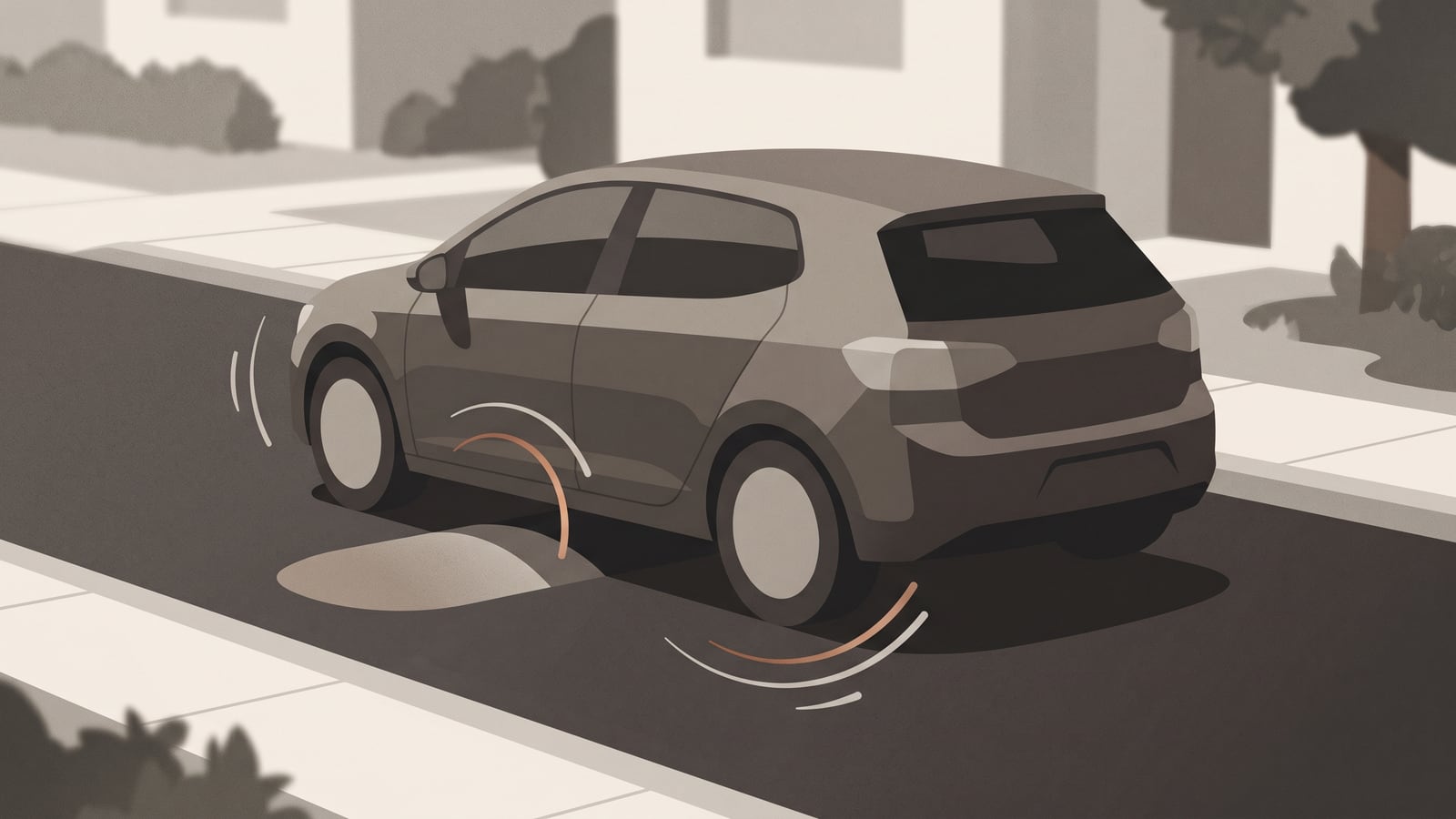
A knock over a speed bump or a rattle on rough tarmac is worth paying attention to. Which part is involved and whether the car is still safe to drive are two separate questions, and mixing them up is what leads owners to either panic over a harmless creak or keep driving on something that's quietly getting worse.
This guide helps you screen for observable reasons to stop, and build a record a workshop can use — not identify the part or certify the car safe. First, a safety screen based on how the car actually behaves, not on how alarming the noise sounds. Second, a way to record what you hear so a workshop can work from a reproducible symptom instead of a vague description. Nothing here asks you to get under the car or use tools you don't already have — the observation is all done from the driver's seat or standing safely beside a parked car.
The immediate safety screen: noise versus vehicle control
A noise by itself, however sharp or sudden, doesn't confirm which component is involved, and its absence doesn't confirm the car is safe. What decides urgency is whether the noise comes with a change in how the car handles, or with a warning sign a manual or inspection scheme treats as serious on its own.
Treat this as your stop signal: an observable loss of normal steering or braking response, unusual vibration through the wheel or pedal, the car pulling to one side, a wheel that looks displaced or insecure, smoke, a burning or fuel smell, a visible fluid leak, or a manufacturer warning light telling you to stop and check your owner manual for what it means on your car. Also stop if the car has recently hit a kerb, pothole, or other object hard enough to cause visible damage, or if you're unsure whether a safety-critical system is working normally. If any of that applies, pull over when it's safe to do so and arrange professional assistance rather than continuing the journey.
If none of those signs are present and steering, braking, and stability all feel normal, this is a case for a planned diagnostic visit rather than an emergency stop — though that judgement only covers what you can observe from inside the car, not the underlying condition of the part making the noise. Official inspection frameworks draw a related line. In Great Britain's MOT roadworthiness inspection, excessive wear or play in a suspension joint is commonly classified as a Major defect requiring repair, while a fault likely to cause a part's detachment or failure, or a real loss of directional stability, is classified as Dangerous — a scheme specific to Great Britain rather than a general rule everywhere. A vehicle recorded with a Dangerous defect isn't driven again until it's repaired. You can't assign these categories yourself from a noise alone; only a physical inspection determines which one applies to your car.
Why cabin listening cannot pinpoint the broken part
It's tempting to assume that a noise you hear near the front passenger footwell must come from something under that footwell. That isn't a safe assumption. Sound can travel through chassis structures, subframes, and body panels before it reaches the cabin, so the perceived location where a noise seems loudest is a useful clue rather than a confirmed source.
Keep that in mind before you name a part to anyone, including yourself. Naming a specific part based on where the noise seemed to come from, and asking a workshop to replace it, risks paying for a part that was never involved while the real cause goes unaddressed. The more useful move isn't to try harder to pinpoint the source yourself — it's to record the conditions under which the noise happens, without guessing at the cause, and let a workshop with the right equipment trace it from there.
The owner-safe boundary: what to observe and what to leave
There's a firm line between recording symptoms and investigating them physically, and it matters because the physical side carries real risk. Any inspection that involves lifting the car, working underneath it, or applying force to a loaded suspension joint belongs to a qualified workshop with proper lifting equipment as part of a professional inspection, because supporting a vehicle on an unsuitable jack or working beneath an unsupported car carries a genuine risk of fatal crushing injury. That holds regardless of how confident you feel or how simple a check looks online.
Your part in this stays entirely above the car: noticing what you feel and hear from the driver's seat, or looking at what's visible while standing or crouching beside a parked, secured vehicle, without touching anything load-bearing.
A workshop can test things you can't safely replicate at home. With the wheel raised and the spring load off a joint, a technician can use a play detector and a pry bar to check for movement that wouldn't show up under normal load, often with an assistant working the wheel or steering while they watch — judgement calls that come from training and experience with what normal versus excessive movement looks like. None of that is available to you standing next to a parked car, and none of it needs to be. Your job is the observation, not the test.
Building a reproducible symptom log
A noise that happens once and is never heard again is hard for anyone to trace. One that happens the same way under the same conditions gives a workshop something to work with. You're not trying to make it happen more often — you're just noting what already occurs on your normal drives. Log these details each time you hear it:
- Sound character. Plain descriptive words: a dull thud, a metallic clatter, a dry creak, a rhythmic click.
- Perceived location. Which corner or area it seems to come from, labelled as your impression rather than a confirmed source.
- Trigger events. What was happening when it occurred — a speed bump, pothole, or rough patch; a sharp turn; braking or accelerating; or steady cruising.
- Speed band. The rough speed range where it shows up and where it goes away — for example present around 30–50 km/h (20–30 mph) but absent above highway speed.
- Load and environment. Alone or carrying passengers and luggage, wet or dry road, cold morning or warm afternoon.
- Onset and duration. Roughly when you first noticed it, and whether it has stayed the same, got louder, or become more frequent since.
- Repeatability. Whether it happens every time on that trigger, or only sometimes.
Copyable symptom log and workshop handover note
Once you've noticed the noise a few times, filling in a record like this gives a service adviser something concrete to work from instead of a description over the phone. A completed log doesn't identify the part or certify that the car is safe — it's a description of conditions, and the safety screen above still governs whether to keep driving before you get to a workshop.
VEHICLE
Make / Model / Year:
Registration / VIN (optional, if you're comfortable sharing it):
Powertrain (petrol, diesel, hybrid, plug-in hybrid, electric, unknown):

SOUND
Description (knock, rattle, clunk, creak, other):
Perceived location (front/rear, left/right, centre, uncertain):
First noticed / how it has changed since:

TRIGGER CONDITIONS
Occurs on (speed bump, rough tarmac, turning, braking/accelerating, other):
Speed band where it appears / disappears (km/h, with mph if useful):
Load (solo, passengers, luggage):
Weather / temperature:
Repeatable every time on this trigger? (yes / sometimes / once):

SAFETY SCREEN
Steering feel normal? (yes/no):
Braking feel normal? (yes/no):
Any pulling to one side? (yes/no):
Any abnormal vibration? (yes/no):
Any dashboard warning light on? (yes/no, which one):
Any smoke, burning/fuel smell, or visible fluid leak? (yes/no):
Wheel looks displaced, loose, or damaged? (yes/no):
Recent impact (kerb, pothole) with visible damage? (yes/no):
Any uncertainty about a safety-critical system? (yes/no):

OUTCOME
[ ] Stop-condition present, or uncertain whether a safety-critical system is working normally — pull over safely, do not continue, check the owner manual for this warning/behaviour, and seek qualified help
[ ] No stop-condition and no uncertainty — routine diagnostic booking

BOOKING SUMMARY (one sentence for the service adviser):
Worked example: from first rattle to booking inspection
Here's how that log plays out for a hypothetical owner. Picture someone driving a ten-year-old hatchback who, over a couple of weeks, keeps noticing a hollow clunk whenever the car crosses a sunken manhole cover on the way to work, consistently somewhere between 30 and 40 km/h (20–25 mph), and more noticeable on cold mornings than in the afternoon.
She runs the full safety screen before deciding anything. Steering feels the same as always, and so does braking. No pulling, no unusual vibration, no warning light on the dashboard. No smoke, no smell, no visible leak. The wheels look normal, and there's been no recent impact. Nothing about how the car handles has changed — only the noise.
Her completed handover note reads something like this:
VEHICLE: 2016 hatchback, petrol

SOUND: Hollow clunk, fairly loud
Perceived location: Seems to come from the front-left, but uncertain
First noticed: About two weeks ago, consistent since

TRIGGER CONDITIONS
Occurs on: One specific sunken manhole cover on the daily commute
Speed band: 30–40 km/h (20–25 mph)
Load: Usually solo driver
Weather / temperature: More noticeable on cold mornings
Repeatable: Yes, every time over that manhole cover

SAFETY SCREEN
Steering / braking / pulling / vibration / warning light: all normal or none
Smoke, smell, leak: none
Wheel condition: normal
Recent impact: none
Uncertainty: none

OUTCOME: No stop-condition and no uncertainty — routine diagnostic booking

BOOKING SUMMARY: "Consistent hollow clunk over one specific sunken manhole cover at 30–40 km/h, more noticeable when cold, no change in steering or braking — would like a running-gear inspection to find the cause."
Because the full safety screen came back clear, this sits in the routine category. She books an inspection and hands over the note without asking the workshop to replace anything specific, since the log doesn't identify which part is at fault, only how the noise behaves.
Booking diagnostic time instead of guessing parts
When you call to book the appointment, the useful thing to authorise is time for a technician to inspect the running gear, not a specific part swap. Handing over the completed log may help the workshop understand the pattern and attempt to reproduce it, rather than starting from a vague description with no conditions attached.
Labour rates and parts prices vary by workshop and location, so this guide can't put a figure on the visit. Diagnostic time turns a vague noise into a specific finding, and any repair approval should rest on what the technician actually finds during that inspection. A workshop that names a specific finding should be able to explain what it is, how they confirmed it, and what happens if you leave it unaddressed — that's the standard to expect from a diagnosis, not just a repair quote.
Where to go next
This guide sits in the symptoms and diagnostics hub, alongside guides on telling a warning light apart from a fault code and a completed diagnosis, on describing a car problem clearly to a workshop, and on logging a fault that doesn't show up every time. If an inspection does turn up a repair decision, comparing repair against replacing an aging car covers that wider decision once you have findings in hand — part of the broader car-ownership coverage on understanding and maintaining a car over time.
Your next step: apply the safety screen above to what you've already noticed — how the car steers, brakes, and feels, plus any warning light currently showing — and check your owner manual for what that warning means for your car.