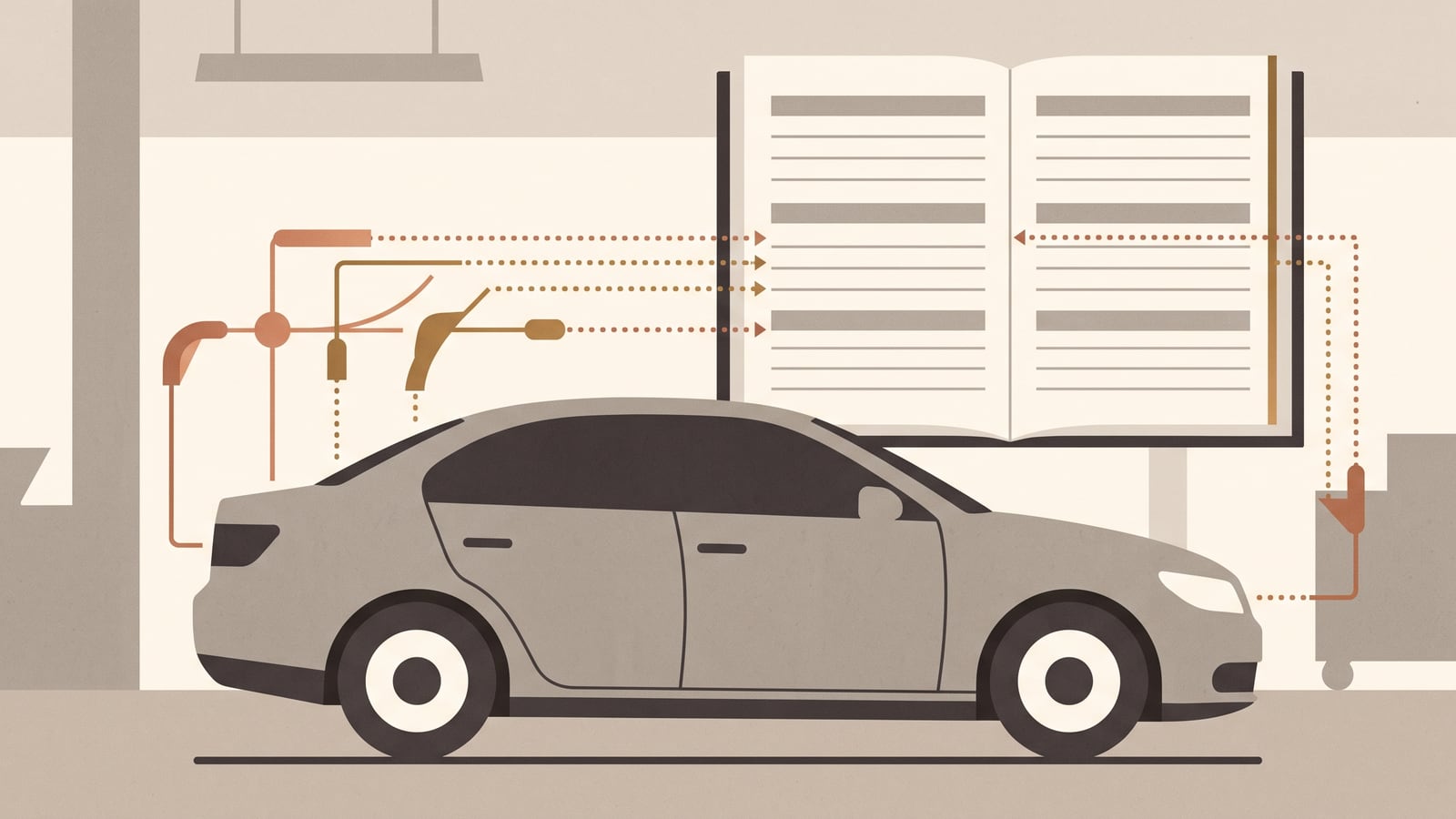
The car did something strange. A shudder, a smell, a dashboard message that flashed and vanished. By the time you can pull over and think about it, the symptom is gone, and you're left trying to describe something you can barely remember to a workshop that wasn't there to see it.
You don't need to name a cause. You need to record what actually happened, once you're safely stopped. That's the whole job this article helps with: a short screen for the moment the fault appears, then a compact log you can copy into a phone note, an email, or a scrap of paper. So next time it happens, you already know what to write down.
Park before you record
Before anything else: don't reach for your phone, a notebook, or a camera while the car is moving. Wait until safely parked before taking notes, photographs, audio, or video. A dashboard message or a strange noise isn't worth documenting mid-drive. Get it right once you've stopped — that matters more than catching the exact instant it happened.
Don't try to make the symptom happen again on purpose, especially in traffic. If it only shows up under certain conditions, chasing those conditions to "catch it on camera" turns an observation into a hazard. The same goes for continuing to drive just to get a better description — that's not what the log is for.
If you genuinely aren't sure whether it's safe to keep driving, the next move is qualified help, not another attempt to reproduce or document the symptom. A completed observation log can't answer that question for you.
And it depends on which vehicle you're in. Three short rules cover it:
- Follow the exact vehicle manual. Use the current manual for the exact vehicle, model year, equipment, powertrain, and market — that's what tells you what a specific dashboard warning means and what it asks you to do. (The 2025 U.S.-market Ford Explorer manual and the 2014 UK Volvo V70 support page don't transfer to another car; they simply show that different warnings can require different responses for the vehicles they cover.) If the manual says stop, switch off, or get help immediately, that instruction outranks any documentation step in this article.
- Follow local emergency and roadworthiness rules. Those come from the governing local authority, not from this guide.
- Get qualified help if you're still unsure. A completed observation log doesn't settle that question — a qualified person does.
Until you're parked, your job is simple: notice, don't record, don't chase the symptom. Once you've stopped, use the current manual and the log below to work out what's next.
Intermittent fault observation log
This is an editorial observation framework, not a diagnosis, and it does not establish that the vehicle is safe to keep driving or that it's roadworthy. What it does is turn a hazy memory into a record a mechanic can use.
It's split into two tiers, so the minutes right after the event don't force you through fifteen fields at once: a core you fill in right away, and an extended set you add later, if you have the time and the details. Leave anything unknown as unknown — don't guess to fill a blank, in either tier.
Record this now
Copy this block into your phone, an email draft, or paper:
Date and time:
Parked or driving:
Trip stage and context:
Conditions observed:
What you noticed:
Reported fault code (if any):
- Date and time.
- Parked or driving when the symptom first showed up.
- Trip stage and context, in plain terms: starting, warming up, or cruising steady; slowing, turning, or parked; or right after switching off. If none of these fits cleanly — several minutes into a cold start while stuck in traffic, say — record how many minutes into the trip it was and what the car was doing, rather than forcing it into one category.
- Conditions observed: weather, road type, and traffic, plus whether the car was loaded and any recent refuelling or charging. Note the outside temperature too, if the car was already displaying it.
- What you noticed — sight, sound, smell, or feel — without naming what caused it.
- Reported fault code, if any — copied exactly as displayed or relayed, and who reported it. This article doesn't interpret it; it's diagnostic information from elsewhere, recorded so a workshop can use it.
Add when you have time
None of this is urgent enough to delay parking or driving safely. Add it once you're settled, from memory or from whatever you captured while parked.
- Information source — who noticed or reported this: you, a passenger, another driver, or someone relaying it to you afterward.
- The exact dashboard wording, colour, or symbol, and whether it stayed on or cleared by itself. Only record this once you've pulled over and stopped — the same distraction limit from above applies here.
- Duration and frequency, this time.
- Prior occurrences, if any — logged separately, each with its own approximate date and conditions, rather than folded into this entry.
- What changed afterward: gone by itself, still present, changed once you stopped, or came back on the next trip.
- Driver response — what the driver did when it happened: kept driving, pulled over, restarted the car, or something else.
- Supporting material, captured only while safely parked — a dashboard photo, a short audio clip. "None" is a fine answer here.
- Previously supplied diagnostic information — anything already given to you before this log, such as a note from an earlier workshop visit. "None" is a fine answer here too.
- Anything unusual right before it happened, written as context rather than an assumed cause — a pothole, a cold start, a long motorway stretch. This isn't the field to name a suspect part.
A short worked entry, entirely invented, to show the pattern rather than a real case:
Trip stage and context: about six minutes into a cold start, still in stop-start traffic — doesn't fit a single category, so logged as minutes-and-activity instead. Information source: driver, reported directly. Exactly what noticed: a brief hesitation when pulling away — "felt like it hung for a second," in the driver's own words. Reported fault code: none supplied. Duration and frequency, this time: a few seconds, once. Prior occurrences: approx. three weeks earlier, similar hesitation, cold morning, no warning noticed. Previously supplied diagnostic information: none. [passenger noticed] a faint smell around the same time — added afterward, kept separate from the driver's own account.
That last line is the pattern worth copying: the driver's own account stays in the observation fields as the driver gave it, and anything a passenger or other helper adds afterward is marked as theirs — [passenger noticed], [helper, checked later], or similar — rather than folded into what the driver directly reported. Nothing here is diagnosed or ruled out; it's a record with its sources kept straight.
Once the log is filled in, you have a compact prompt ready for the shop:
"Here is what happened, when it happened, the conditions I observed, and the exact warning information. What would you need to inspect or test before deciding on the cause?"
That question does the useful thing: it hands over your account and asks the workshop to do the diagnostic work, instead of asking them to confirm a guess you've already made.
Four different things
Getting this straight helps you talk to a workshop without accidentally overstating what you know.
- An observation is what you directly noticed — a smell, a sound, a hesitation.
- A warning indicator or message is information the vehicle itself displays. What it means and what it's asking you to do comes from the current manual for the exact vehicle, model year, equipment, powertrain, and market — not a general table, and not another car's manual.
- A reported fault code is diagnostic information, if a workshop or other party has already supplied one. This article doesn't interpret it for you — include it in your record so a qualified workshop can assess it.
- A diagnosis is the conclusion reached after proper assessment and testing — the step none of the above skip you to.
One way to see how these stay separate in practice: in this California emissions form, recorded information is separate from the final-diagnosis field — trouble codes, freeze-frame data, and test results each get their own space, apart from the diagnosis itself. That's a narrow illustration from one emissions-testing process in one U.S. state; it doesn't extend to other systems or jurisdictions.
What not to do
A few habits turn a useful record into wasted effort, or worse:
- Don't deliberately recreate the symptom to "confirm" it, particularly in traffic.
- Don't use a phone, camera, notebook, or recorder while driving.
- Don't replace a part just because its name showed up in a warning, a reported code, or something you read online. Let a workshop interpret that information with proper testing.
- Don't treat the symptom's disappearance as proof it's resolved. Intermittent problems are intermittent — going quiet isn't the same as going away.
- Don't treat a completed log as proof the car is safe or roadworthy. It's a record of what you saw, nothing more.
This guide also stays out of anything beyond passive observation and parked documentation. It won't walk you through:
- Scan-tool use, clearing codes, or resetting warnings
- Drive cycles or dismantling anything
- Working under the car, or touching brakes, steering, restraints, fuel, or high-voltage systems
That work belongs to whoever is qualified to do it.
Give the workshop the pattern
A stack of log entries is useful to you, but it helps to open with the shape of the problem in a few sentences before handing over the detail. One sequence Autonelio suggests: start with what you observed, say when it last happened and how often, give the exact warning wording if there was one, then hand over the log.
Picture an owner whose car hesitated briefly, twice, on otherwise ordinary trips, and once displayed a dashboard message that cleared on its own. Their opening description to the workshop might run: "The car hesitated for a moment twice this week, both times a few minutes into a normal drive. Once a message appeared on the dashboard and disappeared after I'd parked — here's the exact wording and when each of these happened." No guess at the cause, no proposed repair, no assumed outcome — just the pattern, backed by the log.
The same template works if you're helping someone else describe their car's fault. What matters is keeping the driver's account and anything you add afterward clearly separate — which details came directly from them, and which you filled in later, from memory or by checking something yourself. The notation in the observation log above ([passenger noticed], [helper, checked later]) shows one way to mark that split on paper. The organised record's value lies in the clarity of the account, avoiding a guess dressed up as a conclusion.
Where to go next
This article sits within Autonelio's hub for spotting and diagnosing car problems, alongside guides that pick up once you've got something written down. If you want a longer, structured write-up beyond the log above, here's how to put together a fuller report for the shop. Before you book the appointment, see what to prepare for a diagnostic visit. And to understand why a dashboard light, a fault code, and a diagnosis aren't the same thing, read what each one can tell you. From there, the wider car ownership section covers maintenance and workshop costs too.
Your next step: once the vehicle is safely parked, copy the observation log into a note so it's ready for the next time this happens.