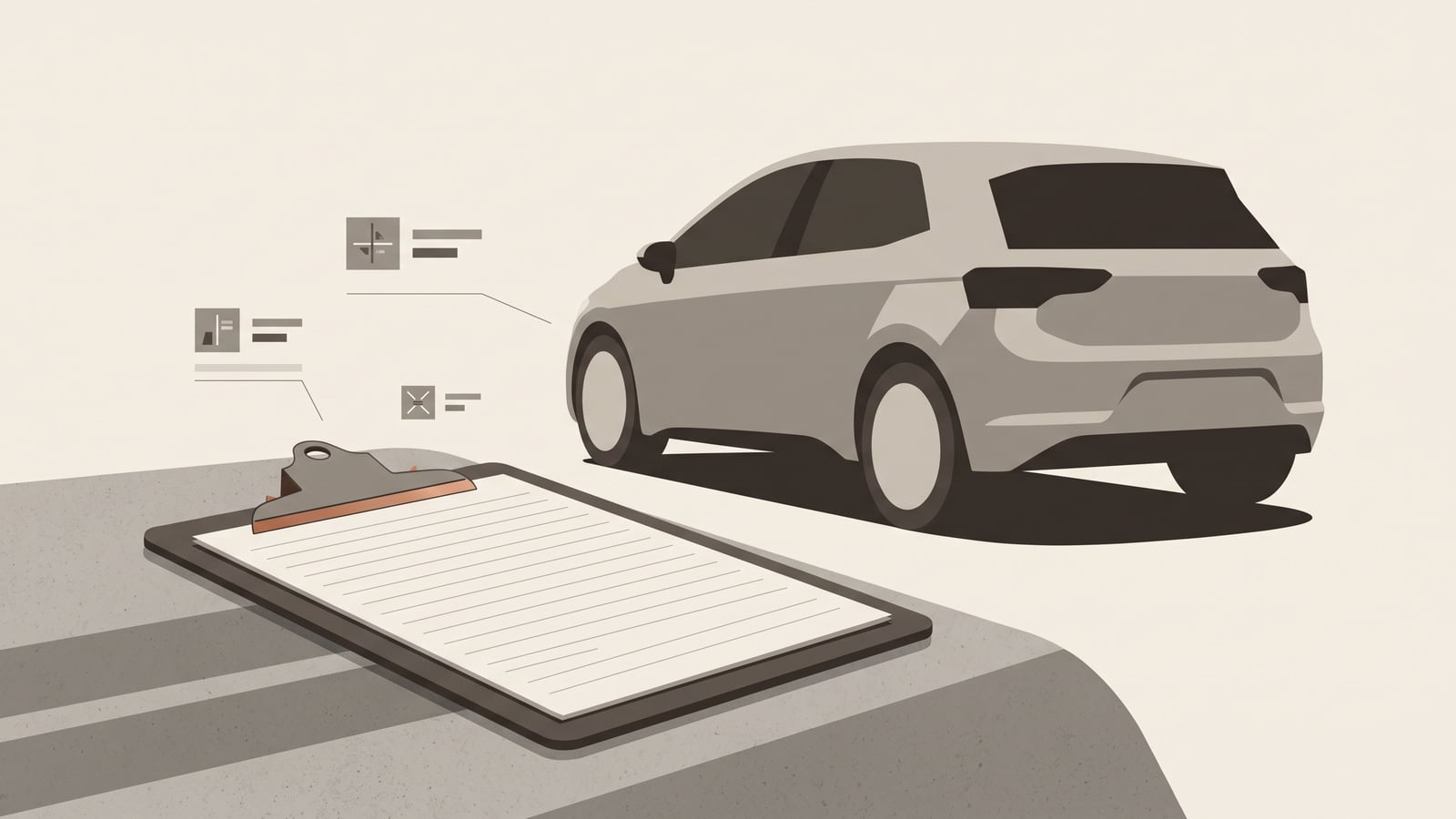
A workshop can only work as well as what you tell it. Say "it makes a noise sometimes" and the technician is starting from nothing. Say "a dull thump from the front left, only over bumps, only when the engine is still cold" and they've got somewhere real to start looking.
That's what this guide is for. First, a quick safety screen — anything that means you should stop driving right now. Then how to tell a symptom apart from a warning light, a fault code, and an actual diagnosis. And finally, a short, copyable record that gives a technician the exact conditions your car was in when something went wrong. Filling it in is a communication tool, not a mechanical clearance: it doesn't tell you the car is safe to drive further, and it doesn't replace a technician's own inspection.
When to Stop Before Recording
Before you write anything down, check whether it's even safe to keep driving. Some symptoms are worth a note in the car park. Others mean pulling over safely, as soon as you reasonably can, and calling for help instead of carrying on.
Stop and get somewhere safe if you notice reduced braking or steering control, smoke, a strong fuel smell, a burning smell, or a tyre or wheel that feels seriously unstable. Once you're stopped, call for roadside assistance rather than trying to limp on to the workshop yourself.
Dashboard warning lamps need one more step. Colour is a rough guide — red generally flags something urgent, amber generally flags something to have checked soon — but colour alone does not tell you what to do next: check the exact symbol against your current owner's manual, because the same amber or red light can call for a different response from one car to another. If a lamp for oil pressure, coolant temperature, or the brake system comes on, don't guess — your manual states what that specific warning requires, and wherever it tells you to stop, stop. If you don't recognise a symbol at all, treat it as unclear rather than harmless until you've looked it up.
Hybrid and electric cars add one more stop condition: damaged high-voltage components, unusual heat from the battery area, hissing, or a chemical smell. Treat any of these like a fuel or fire hazard — stop, move well clear of the car, and get professional help.
Whatever the symptom, never try to reproduce it in a way that's unsafe. Don't push a failing brake pedal harder to see how bad it gets, and don't keep driving on a wheel that feels like it's about to fail just to gather more detail. Any inspection you do yourself should stay within a safe position: do not get under the car, open up assemblies, or handle fluids — that part of the job belongs to a qualified workshop. A good record comes from what you noticed during ordinary driving, not from tests you invented on the spot.
Describe the Symptom, Not the Part
Once the car's parked safely, the instinct is to work out what's broken. Resist it. Your job is to describe what happened — the sound, the feel, the timing — and let the technician's diagnosis identify the cause. Guess at the part and you risk sending the workshop down the wrong path, or paying to replace something that was never the problem.
It helps to keep four things separate in your head, because they're genuinely different.
A symptom is what you observed — a noise, a smell, a vibration, a change in how the car behaves. A dashboard warning or message is text or a symbol the car displays; record it exactly as shown, then check it against the manual. A diagnostic trouble code (DTC), if one has been read by a scan tool, is a separate, more technical layer: it's not a diagnosis — reading a code only tells you which circuit or condition triggered it, not that the part it's named after has actually failed. A diagnosis is the technician's conclusion after they've tested the system and connected the symptom to an actual physical cause. Only the fourth one tells you what's really wrong.
This matters because a clear, specific description of the symptom is often more useful at intake than a code name alone — it's the raw evidence a code can't capture, like exactly when a noise happens or what the car was doing at the time. A good intake note preserves the conditions the workshop can verify and use when planning what to test, and that's worth having whatever the eventual cause turns out to be.
What to Notice and Write Down
Break the record into six categories. None of them need mechanical knowledge — they're all things you can notice as a driver.
- Sensory detail. What did you actually sense? A click, a grind, a squeal, a thump. A vibration you feel in the steering wheel versus one you feel through the brake pedal or the seat. A smell — burning, fuel, something sweet, rubber. Something you saw — smoke, a fluid drop and its colour and location, a warning symbol lit up.
- Operating conditions. What was the car doing? Note the speed, whether the engine was cold or warmed up, and whether you were turning, braking, accelerating, or cruising steadily. Add the road surface, the weather, and whether you had extra passengers or a heavy load aboard.
- Sequence and timing. What happened just before the symptom, during it, and right after, and roughly how long it lasted. A noise that starts on start-up and fades is a different clue from one that only appears under load.
- Frequency and change over time. Does it happen every time, only sometimes, or just once? Is it getting worse, getting better, or staying the same?
- When it doesn't happen. A symptom that's absent under some conditions is genuinely useful, especially for an intermittent fault — it helps define when the problem can and can't be observed. A noise that vanishes on a smooth motorway but returns over speed bumps tells a technician something a constant noise never could.
- Recent history and anything you've already tried. Note anything you changed or had done recently — a service, a fuel or charge top-up, new tyres, an impact or pothole strike, a stretch sitting unused, or a heavier-than-usual load. Add anything you've already checked, adjusted, or had looked at, and what happened as a result.
Everything on this list is something you can notice from the driver's seat or from a safe position beside the parked car; the same boundary from the section above still applies if you're tempted to look closer. Write down what you're sure of, and mark anything uncertain as unknown rather than filling the gap with a guess. A blank field is honest information; a guessed one can send a diagnosis in the wrong direction.
Copyable Symptom-Record Template
A completed record gives the technician a starting point for their own inspection — it doesn't prove the car is fit to drive. Treat every field below as an observation, not a clearance.
Copy this into a notes app, an email, or a printed page, and fill it in as soon as you can after the event, while the details are still fresh. Leave any field blank or mark it "not observed" or "unknown" rather than guessing.
VEHICLE
Make / model / year:
Powertrain, if known (petrol, diesel, hybrid, plug-in hybrid, electric):
Approximate odometer reading:

RECORD
Date and time of observation:
One-sentence summary of the concern:
Vehicle state when it happened (parked, starting, moving):

ONSET, FREQUENCY, AND CHANGE
New, gradual, intermittent, or continuous:
How often it happens (every trip / occasional / once only):
Getting worse, better, or staying the same:

SEQUENCE
What happened immediately before, during, and after:
Approximate duration:

OPERATING CONDITIONS
Speed:
Engine cold or warmed up:
Accelerating / braking / turning / cruising:
Driver side, passenger side, front, or rear, if it's clear which:

ENVIRONMENT AND LOAD
Weather and ambient temperature:
Road surface:
Passengers or cargo on board:
Any recent impact, pothole strike, or unusual weather exposure:

SENSORY OBSERVATIONS
Sight (smoke, fluid, warning symbol) — or "not observed":
Sound — or "not observed":
Smell — or "not observed":
Feel / vibration, and where you felt it — or "not observed":

DASHBOARD WARNINGS
Exact wording or symbol displayed — or "none observed":
What the current owner's manual says about that warning:

WHEN IT DOES NOT HAPPEN
Conditions where the car behaves normally:

RECENT HISTORY AND WHAT YOU'VE ALREADY TRIED
Recent servicing, fuel or charge top-up, tyre changes, heavy load, or storage:
Anything already checked, adjusted, or looked at, and the result:

HAZARD CHECK
Reduced braking or steering, smoke, fuel or burning smell, severe tyre or
wheel instability, or a manual stop instruction, at any point:
[ ] One or more present or uncertain — stopped and arranged recovery or
    roadside assistance rather than continuing to drive
[ ] None observed (this doesn't confirm the car is safe to keep driving —
    it only records what was and wasn't noticed)

WORKSHOP HANDOFF
"Please investigate the cause of this symptom under the conditions described
above before recommending any parts replacement."
Completed Worked Example
Here's what a filled-in version might look like, for a hypothetical owner who's noticed an intermittent knock from the front of the car on cold mornings.
VEHICLE
Make / model / year: Hypothetical hatchback, mid-size, roughly 8 years old
Powertrain: Petrol
Approximate odometer reading: around 95,000 km

RECORD
Date and time of observation: Weekday mornings, roughly 07:15, over the
past 10 days
One-sentence summary of the concern: A dull, rhythmic knock from the front
left of the car when turning left over uneven tarmac, only on cold mornings.
Vehicle state when it happened: Moving, low speed

ONSET, FREQUENCY, AND CHANGE
New, gradual, intermittent, or continuous: Started roughly two weeks ago
How often it happens: Most cold mornings on the same rough side street;
not noticed on smooth roads or once the car has warmed up
Getting worse, better, or staying the same: Seems about the same each time

SEQUENCE
What happened before, during, and after: No warning before it; one or two
thumps as the car turns and crosses the uneven section; nothing after
Approximate duration: Under a second each time

OPERATING CONDITIONS
Speed: Under 20 km/h
Engine cold or warmed up: Cold — within the first five minutes of driving
Accelerating / braking / turning / cruising: While turning left, over a
speed bump or pothole
Driver side, passenger side, front, or rear: Sounds like the front left

ENVIRONMENT AND LOAD
Weather and ambient temperature: Cool mornings, around 5°C
Road surface: Rough, patched tarmac on one specific street
Passengers or cargo on board: Usually just the driver
Recent impact or weather exposure: Not observed

SENSORY OBSERVATIONS
Sight: Not observed — no visible fluid, no smoke
Sound: A dull, rhythmic thump, not a sharp metallic scrape
Smell: Not observed
Feel: A faint knock felt through the floor, not through the steering wheel
or the brake pedal

DASHBOARD WARNINGS
Exact wording or symbol displayed: None observed — no warning lamp has
come on
Manual entry: Not applicable — no warning shown

WHEN IT DOES NOT HAPPEN
Conditions where the car behaves normally: Silent on the motorway, silent
once the car has been driven for ten minutes or more, silent on smooth
roads even when cold

RECENT HISTORY AND WHAT YOU'VE ALREADY TRIED
Recent servicing, fuel or charge top-up, tyre changes, heavy load, or
storage: Routine service three months ago; no recent tyre change; no
unusual load
Already checked or tried: Nothing yet — noise noticed too recently to
have investigated

HAZARD CHECK
[ ] One or more present or uncertain
[X] None observed (this doesn't confirm the car is safe to keep driving —
    it only records what wasn't noticed)

WORKSHOP HANDOFF
"Please investigate the cause of this front-left knock under the cold,
low-speed, turning-left conditions described above before recommending
any parts replacement."
Notice what this owner didn't do: they didn't decide which component was responsible, and they didn't invent a smell or a warning light that wasn't there. They wrote down what they were sure of, marked the rest unknown, and left the hazard check as an honest record rather than a verdict — the same caution about driving safety applies here too. That gives the workshop the exact conditions to verify: cold, low speed, one direction, rough surface. It lets them decide what to test, instead of working from a vague complaint or a guessed cause. In this hypothetical, the owner's bounded next move is to hand this record to the workshop and follow whatever manufacturer or qualified-professional advice follows, rather than attempt a repair themselves.
Where to go next
This guide sits in the symptoms and diagnostics hub. From here, preparing for a diagnostic appointment covers what else to bring alongside this record, and warning light, fault code, and diagnosis: what each one can tell you goes deeper into the distinction this guide only introduces. If your concern comes and goes, what to record when a fault is intermittent extends the absence-condition tracking above. For everything else about owning and maintaining a car, the wider car ownership section covers getting started, maintenance, and workshop costs.
Your next step: Open your vehicle's glovebox or digital owner's manual, find the dashboard symbol index, and copy the exact wording of any active warning indicator into the template above before you book the diagnostic appointment.