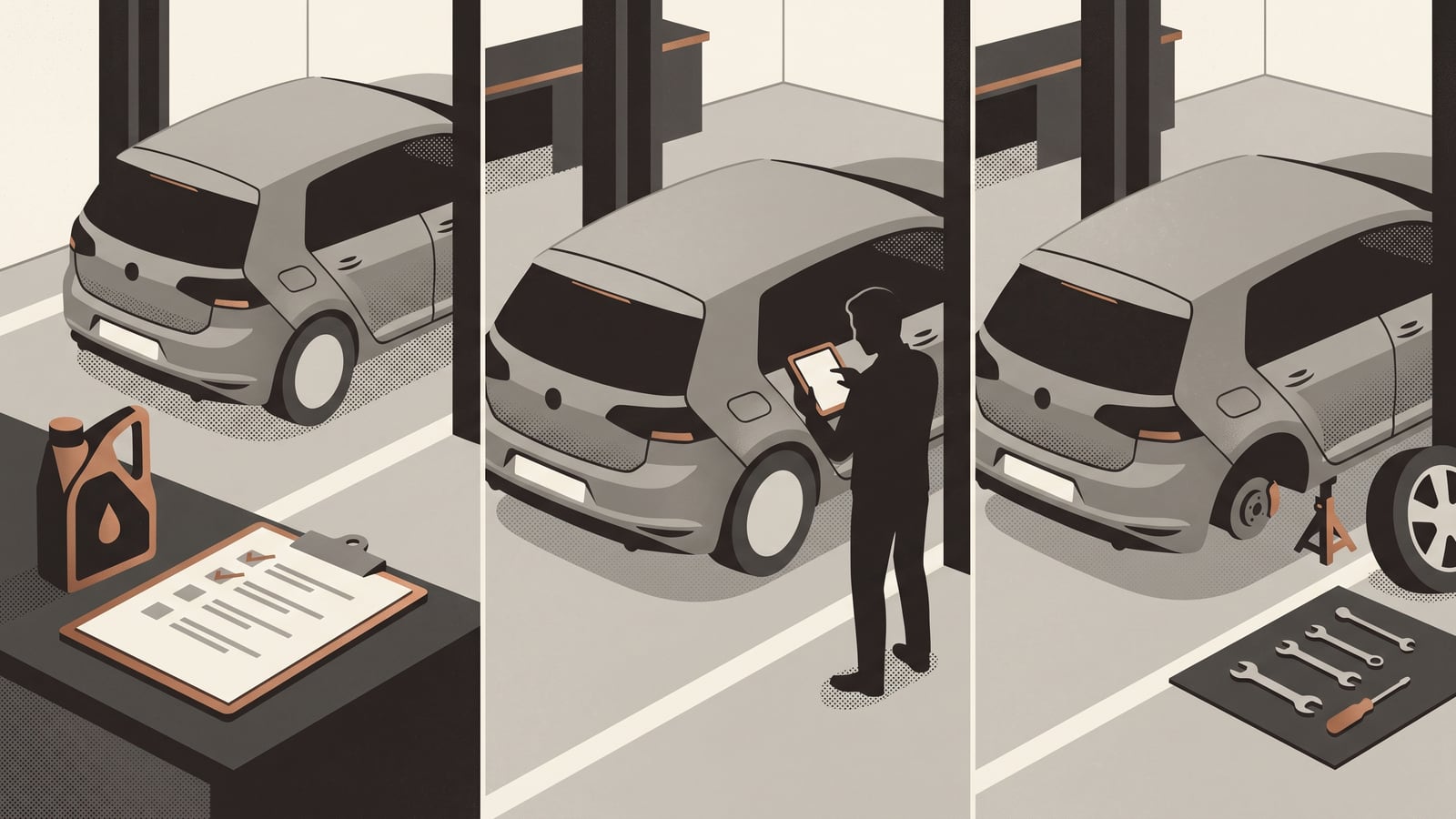
A workshop tells you the car needs "a service." That word can mean almost anything: a scheduled item ticked off, a fault written down, a theory tested, or a part replaced. Before you say yes to anything, it helps to know which of four different jobs you're authorising — and to settle whether the car's current warnings mean you should be doing something else first.
Scheduled maintenance applies when the current schedule for your exact car says an item is due. A condition check applies when something is visible or audible but there's no unexplained performance problem to chase. Diagnosis applies once a symptom, a warning light, or a stored code doesn't explain itself — but only after you've dealt with whatever your vehicle's own instructions say about that warning. And repair is the right word only once someone has a supported finding and a bounded proposal for what to do about it. A visit casually called a "service" can move through more than one of these stages in a single appointment, but the word alone doesn't tell you whether diagnosis happened at all.
Four jobs, four answers
These four activities are connected — a service visit can pass through several of them — but they're not interchangeable, and none of them alone proves the car is safe, roadworthy, correctly diagnosed, or properly repaired.
| Stage | Immediate trigger | Question it answers | Expected output | Main limitation |
|---|---|---|---|---|
| Scheduled maintenance | An item is due on the current schedule for the exact vehicle | What does the schedule call for now? | A record of the schedule consulted, the item authorised, and the work done | Doesn't explain a symptom that isn't on the schedule |
| Condition check | Something observable, without an unexplained performance concern | What can be seen or recorded right now? | A specific observation — what, where, when | Doesn't establish a cause, and doesn't replace maintenance or diagnosis |
| Diagnosis | An unexplained symptom, warning, or code | Why is this happening? | Evidence considered, a supported finding, or an honest statement of remaining uncertainty | The actual tests depend on the vehicle, system, and available service information |
| Repair | A supported finding with an agreed plan | Does the fix address the finding? | A work record plus a relevant verification result | Doing the work isn't the same as confirming it worked |
Check safety first
Before you sort any of the above out, there's a screen that comes first. The current instructions for your exact vehicle govern what you do about a displayed warning; if they tell you to stop, stop as safely as traffic and road conditions allow, rather than continuing to drive so you can gather more to tell the workshop. If a problem looks safety-critical, if a warning calls for prompt service, or if you're genuinely unsure whether it's safe to keep driving, get qualified help rather than deciding that yourself.
As one small example of why responses differ: the Ford manual variant we reviewed gives stop instructions for its coolant-temperature and low-oil-pressure warnings, but different wording for its brake warning. Don't generalise those specific responses, or the symbols involved, to other vehicles — the point is only that warning responses genuinely differ by manufacturer and system, and the manual for your own car is the authority on what yours means.
What's left for you to do once safety is settled? Read those instructions, observe and record what's happening, keep the paperwork, and prepare your questions for the workshop. That's the boundary: no testing, no disassembly, no lifting the car or working underneath it, and nothing touching brakes, steering, restraints, fuel, or high-voltage systems. That belongs to a qualified professional.
Scheduled maintenance
Scheduled maintenance is triggered by the schedule that applies to your specific vehicle and market — not a generic interval you half-remember, and not another car's dashboard reminder. The question it answers is narrow: what item does the schedule call for right now? Its output should be equally narrow — a record naming which schedule was consulted, which item was authorised, and what was done.
As one narrowly scoped example, a Ford owner's manual we reviewed states that its maintenance indicator light is meant to supplement the maintenance tables, and that the tables take precedence if the two disagree. That's true for the specific manual we looked at; treat it as an illustration of how an indicator and a written schedule can relate, not as a claim about intervals or about any other make. This route suits you when a known scheduled item is due. It's the wrong tool when the concern is something unexplained — a noise, a smell, a warning that wasn't expected — because completing a scheduled item doesn't investigate or explain something the schedule never anticipated.
Condition check
We're using "condition check" in this article as our own organising label for observing and recording the vehicle's present condition, without yet claiming why — a term this guide uses to structure the explanation, rather than a category defined the same way everywhere you might take the car. The test is whether there's an unexplained behaviour anywhere in the story: a condition check covers only something you can already point to, with no performance mystery attached and no service instruction from a warning. A warning that has told you to arrange service is diagnosis territory from that point on, even on a day it isn't currently lit.
A useful condition-check output says what appeared, where, and when — a mark on the driveway, a sound on cold starts, a vibration at a particular speed — rather than jumping to a claimed cause. That's the benefit: it preserves specific evidence you can hand to a workshop later, instead of a vague memory. The limitation is real too: it may leave the cause completely unresolved, and it doesn't stand in for either the scheduled maintenance the car might also need or the diagnosis a genuinely unexplained problem requires. This route fits when you've noticed something but nothing points to an urgent safety concern. It's a poor fit once the manual tells you to stop, or once a workshop already has a supported finding and the next step is about repair.
Diagnosis
Diagnosis starts once a concern doesn't explain itself. Within ASE's advanced powertrain scope, that work can include confirming the concern is real, finding the service information that applies to that vehicle, choosing tests based on the vehicle's data, weighing what the evidence shows, and identifying a likely cause — or stating that the cause remains uncertain; but the actual tests depend on the vehicle, the system involved, and the service information available for it. That sequence describes the shape of the work, not a fixed recipe that applies everywhere.
A stored diagnostic trouble code — often just called a code — is an OBD-related identifier the car's onboard system records. It's one input to that investigation, not the whole diagnosis: material we reviewed treats a code as one signal among several, alongside things like live data readings, the snapshot of conditions when the code was set, monitor status, and direct measurements, all weighed together rather than read in isolation. A code can point an investigation in a useful direction, but it's a mistake to treat it as a standing order to swap the part it names — that skips the interpretation step. This caution applies specifically to onboard-diagnostic-related powertrain work, not to every warning light on the dashboard.
Repair and verification
Repair is what happens after diagnosis has produced a supported finding: someone does the work that finding calls for. Within ASE's advanced powertrain, emissions and OBD-related material, obtaining a relevant verification result is treated as distinct from performing the work itself — one is doing the job, the other is checking whether it achieved its purpose, and neither substitutes for the other. What counts as a "relevant" check depends on the concern and the work done; there's no single test that applies across the board.
Repair suits a situation where the finding is genuinely supported and the proposed work is clear — the concern has moved from being investigated to being acted on. The limitation is easy to miss under time pressure: doing the work, or even seeing a warning light go out, doesn't by itself demonstrate that the underlying cause is gone. Repair is the wrong stage to jump to when all you have is an observation, a warning, or a code, and nobody has yet connected it to a supported cause.
Which route fits?
This table helps you figure out which question to ask next. Its columns cover the same ground as the stage table above, under slightly different names — trigger, question, expected output, and next step — so use whichever phrasing sits better with your situation. It can't confirm a fault, prove the car's safe or roadworthy, or replace the instructions specific to your vehicle.
| Route | Trigger | Question answered | Evidence or record expected | Bounded next step |
|---|---|---|---|---|
| Scheduled maintenance | Current schedule shows an item due | What does the schedule call for? | Schedule consulted + item authorised + work record | Decide whether to authorise the stated item |
| Condition record | Something visible or reported, no unexplained performance concern | What can be observed right now? | What, where, when | Decide whether monitoring or diagnosis is warranted next |
| Diagnosis | Unexplained symptom, warning, or OBD-related code — after the safety screen | Why is this happening? | Evidence considered + supported finding, or stated uncertainty | Decide between further diagnosis and a repair proposal |
| Repair | A supported finding exists, work is agreed | Does the fix address the finding? | Work record + relevant verification result | Decide whether the result supports closing this or reopening diagnosis |
Four situations, start to finish
These are hypothetical, meant to show how the framework plays out — not a record of any real vehicle.
A schedule entry. An owner checks the current schedule for their car and finds an item is due. That's a straightforward classification: scheduled maintenance. The expected output is a record naming the schedule and the authorised item. If the paperwork matches that scope, the bounded decision is simple — authorise the stated item or don't.
A present observation. Another owner notices a recurring mark under the car or an odd sound, but nothing points to an unexplained performance problem yet. This starts as a condition check. The output records what happened, where, and under what ordinary circumstances — not a guessed cause. Because that alone doesn't establish a cause, the next decision, after the safety screen, is whether the observation is worth monitoring or whether it warrants moving into diagnosis.
An unexplained concern with a generic stored code. A third owner has a warning light and a stored code that doesn't explain itself. This is diagnosis territory. The expected output is the evidence considered, a supported finding if one emerges, or an honest statement that the cause remains uncertain. If the finding stays uncertain, the code by itself isn't grounds to replace the component it names — it's one input to weigh among several, not a verdict — so the bounded next decision is further diagnosis rather than jumping straight to a part swap.
A supported finding. A fourth owner's workshop has already produced a supported finding and proposed a bounded piece of work. This is repair. The expected outputs are a record of the work done and a relevant check of whether it addressed the finding. If that check is inconclusive, the sensible next step is returning to diagnosis — an inconclusive result doesn't confirm the repair worked, and neither the aid above nor a single post-repair check settles that on its own.
One appointment, two tracks. A fifth owner books what the workshop calls "a service" for two reasons at once: an oil change that's due on schedule, and a rattling noise under acceleration that showed up last week. Booking it as one visit doesn't make it one job — the reader records each reason separately. The scheduled-maintenance track: trigger is the due oil change, the question is what the schedule calls for, and the expected output is the schedule consulted plus the item authorised. The diagnosis track: trigger is the unexplained rattle, the question is why it's happening, and the expected output is evidence considered and either a supported finding or stated uncertainty. Each track also gets its own authorisation boundary — approving the oil change doesn't approve diagnostic time on the rattle, and the reverse. The bounded step here isn't a diagnosis; it's telling the workshop, before the visit, that both items need their own record and their own sign-off.
A prompt you can copy
What follows is an optional prompt we've drafted to help you ask a clear question — you may ask a workshop to fill in something like it, but it isn't something every workshop is obliged to provide, and it doesn't create a legal right to a particular answer.
- Reason for visit:
- Scheduled item or observation:
- Confirmed finding:
- Remaining uncertainty:
- Proposed work:
- Authorisation boundary:
- Record requested:
A representative completed portion, to show what "observation" and "finding" look like as different things, not to suggest any real vehicle's condition:
Observation: warning appeared once. Confirmed finding: none yet. Uncertainty: cause not established. Authorisation boundary: diagnosis only before additional work.
When one appointment covers more than one reason for visit — as in the two-track appointment above — copy this prompt once per reason rather than blending the tracks into a single set of answers.
Because you're about to apply a generic prompt to a specific car, check your vehicle's current instructions before you sign off on anything — the applicable schedule, warning meanings, and requirements vary by vehicle and market, and this template can't know them for you.
Three common mix-ups
"It was in for a service, so they'd have caught anything wrong." A service visit that completes scheduled items doesn't automatically include diagnosis of something the schedule never anticipated. What's missing, if diagnosis didn't happen, is any record of an unexplained concern being investigated at all — no evidence considered, no finding, no stated uncertainty. That's not a knock on the workshop; different shops use "service" to mean different bundles of work, and asking what was checked clears it up without assuming anyone was careless.
"The light came on, so they know what's wrong." A warning light or a stored code is evidence, not a finding. What's missing is the interpretation step — the evidence considered and a supported cause, or an honest "we're not sure yet." Asking to see that step is a fair question, not an accusation.
"They said it needs a new part, so it needs a new part." A suggested repair is only as good as the finding behind it. What's missing, if the workshop can't describe the finding, is the connection between the observed evidence and the proposed work.
Where to go next
This article sits in the getting-started hub, alongside guides built for the same early decisions. If you want to work out what your car's schedule is calling for, How to Read a Manufacturer Maintenance Schedule walks through that. For the difference between a warning light, a fault code, and a diagnosis, see Warning Light, Fault Code, and Diagnosis: What Each One Can Tell You. Once you have an estimate to weigh, How to Compare Two Car Repair Estimates Before You Choose and How to Work With a Repair Shop: From Booking to the Final Invoice cover the practical side of the visit. All of this sits inside the wider car ownership section, which covers the whole span from buying decisions to day-to-day running costs.
Your next step: open the current instructions for your exact vehicle, find what they say about the item that's due or the warning you're seeing, and bring that specific detail to the workshop when you ask your question.