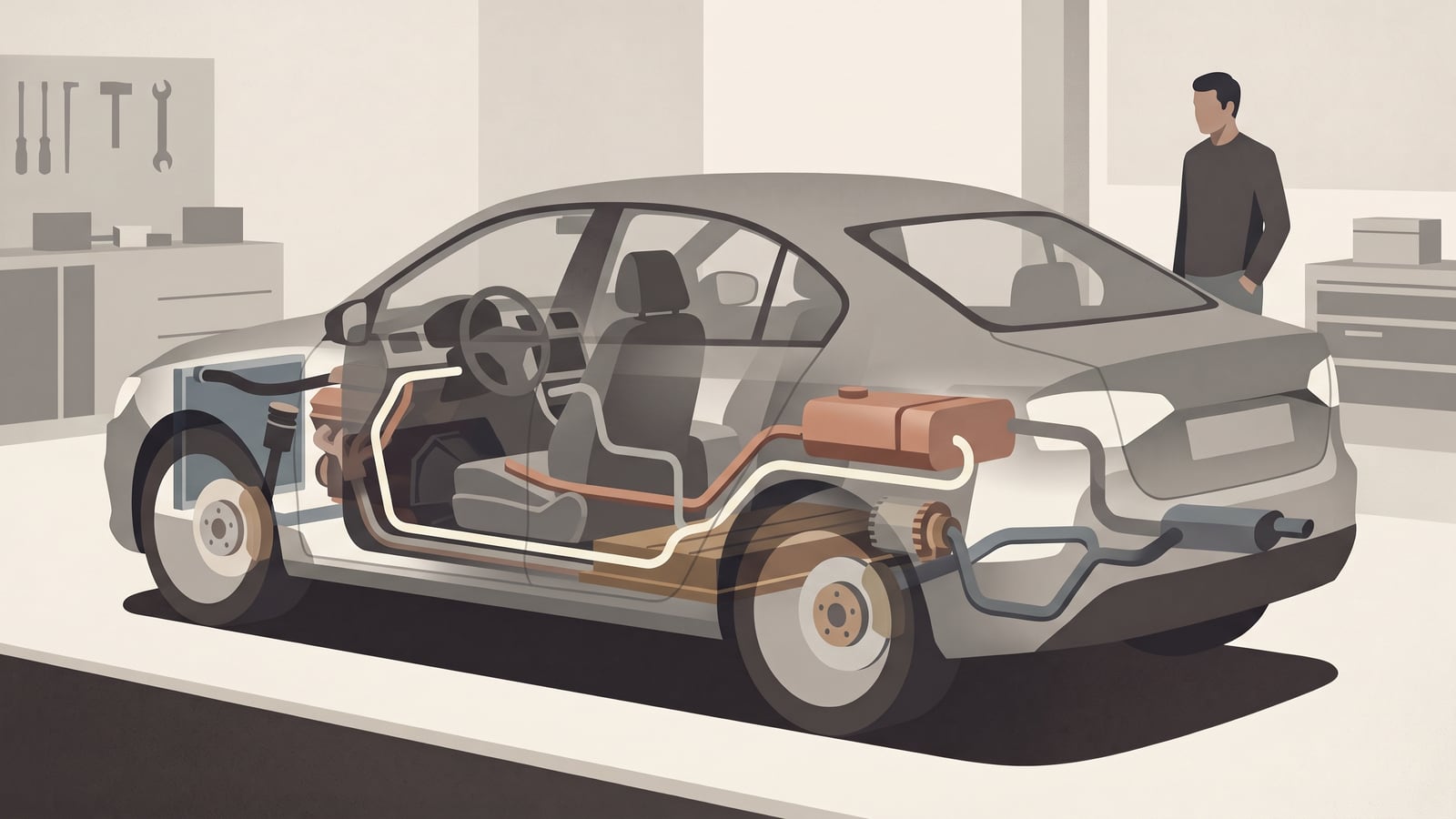
A car makes more sense once you stop trying to picture every part under the bonnet and start following three simpler threads instead: where the energy comes from, how that energy turns into forward motion, and what information passes back and forth between the car and you. Once you can trace those three paths, most of what a handbook, a warning light, or a workshop tells you starts to fit somewhere.
This is a map, not a manual. It sketches the typical architecture of a gasoline car, a non-plug-in gasoline hybrid, and a battery-electric car; the exact arrangement varies by vehicle and powertrain, so treat it as a general map rather than your own car's exact layout. It also shows a handful of places where those systems meet — a monitoring light, a braking event, a tyre sensor, an airbag — but it isn't a parts catalogue for your specific car, a diagnosis of anything that's gone wrong, or a roadworthiness check. The current handbook for the exact make, model, model year, market and powertrain is the authority on what your car actually has, how it's meant to be used, and what you're allowed to do to it yourself — anything beyond that owner-safe boundary belongs with qualified service, and any rule that depends on where you live is governed by the relevant local authority, not this article.
A few systems deserve an upfront word about what's missing. Conventional hydraulic braking, base steering, and suspension aren't covered here as general systems: you'll meet braking only through its relationship with regenerative braking, and steering only through one driver-assistance example. Suspension doesn't appear at all. These are large, safety-critical subjects with their own guidance elsewhere, and a short general sketch of them would mislead more than it would help.
Three propulsion maps
The clearest way to see how one car differs from another is to follow the same question through each type: where does the energy start, and what does it pass through on the way to the wheels? This article compares three typical architectures: a gasoline car, a non-plug-in gasoline hybrid, and a battery-electric car. Hybrids especially come in more than one type and arrangement, so treat what follows as one typical shape among several, not a fixed diagram.
Gasoline: fuel to wheels
In a typical spark-ignition gasoline (petrol) car, fuel travels from the tank through the fuel-delivery system, mixes with air, and gets ignited by a spark plug. The resulting mechanical power then passes through the transmission to the drive wheels.
An electronic control module sits over the top of this process. It manages things like the fuel-to-air mixture and spark timing, watches how the engine is running, and can flag when something falls outside its expected range. That's monitoring — the module notices when something looks off, not why it's wrong — and it's a distinction worth keeping in mind as this map goes on. Where the car has emissions-control equipment, the exhaust system carries combustion gases through it, which may include a three-way catalyst where fitted.
Hybrid: two paths together
A typical non-plug-in gasoline hybrid runs its engine and one or more electric motors side by side, and it's built to move between them, or blend them, depending on what the car is doing. Its traction battery — the pack that powers the electric motor — gets replenished two ways: some charge comes back through regenerative braking as the car slows, and some comes from the engine while it's running.
Underneath that, power electronics manage the flow of electrical energy around the car, and thermal management keeps components at the right operating temperature. A DC/DC converter supplies the car's ordinary lower-voltage functions — lighting, instruments, and the like — and keeps a separate 12-volt auxiliary battery topped up. Power reaching the wheels can come from the engine, the motor, or both together, and how that split is handled differs between manufacturers. Treat this as one illustrative shape among several hybrid designs, not a fixed blueprint.
Electric: charge to wheels
A typical battery-electric car swaps the fuel tank and engine for a traction battery and an electric motor, and it draws its energy from an external charging connection rather than a fuel pump. Plugging into AC power feeds an onboard charger, which converts that incoming electricity to DC for the traction battery. From there, a power-electronics controller manages current to the motor, and the motor turns the wheels through an electric transmission.
As with the hybrid, a DC/DC converter and a 12-volt auxiliary battery handle the car's lower-voltage functions separately from the high-voltage traction system. What this map doesn't have, compared with the gasoline one, is an engine, a liquid-fuel supply, or tailpipe exhaust components — there's nothing to burn or exhaust. That's an architectural difference only; this map doesn't address the electricity's origin or its wider environmental footprint.
The three maps compared
Put side by side, an ordinary refuelling or recharging moment already shows how differently these three cars are built. A gasoline car takes on liquid fuel. A non-plug-in hybrid does the same, but also tops itself up quietly through regenerative braking and engine charging as you drive. A battery-electric car takes on electricity from outside, managed by the car's own charging system.
| Typical gasoline car | Typical non-plug-in hybrid | Typical battery-electric car | |
|---|---|---|---|
| Primary energy | Liquid fuel | Liquid fuel, supplemented by electricity | Electricity from external charging |
| Conversion & drive delivery | Engine through a transmission | Engine and/or motor through hybrid drive delivery | Motor through an electric transmission |
| Replenishment | Refuelling | Refuelling, plus regenerative braking and engine charging | External charging, managed by the car |
| Lower-voltage supply | Not established by this map | DC/DC converter and auxiliary battery | DC/DC converter and auxiliary battery |
| Combustion & exhaust equipment | Present | Present, alongside electric components | Absent |
This is an architecture comparison, not a ranking. Each row answers the same functional question for each car; none of it tells you which one costs less to run, suits your driving pattern, or is the right one for you to buy.
What the warning lights tell you
A tyre-pressure monitoring system is a clean, bounded example of how a car's electronics can communicate a monitored condition to the driver. On a car equipped with one, tyre or other vehicle sensors send signals to an onboard processor, which may light up a dashboard indicator once pressure in a tyre drops below the system's acceptable level. That's genuinely useful information. But it communicates a monitored condition — it does not establish the failed part or a completed diagnosis, and it doesn't tell you the car is safe to drive, roadworthy, or that any repair has actually fixed anything.
Where systems meet
None of the systems above work in isolation, and a few places where they meet are worth knowing before you talk to a workshop or open a handbook. Everything in this article is conceptual: understanding what a system does, watching how your car behaves, and reading the handbook. It isn't an invitation to open anything up. Work involving high voltage, brakes, steering or restraints, fuel systems, lifting the car, or heat and pressure sits outside that boundary and belongs with qualified service.
Regeneration and braking
In an electrified car — hybrid or battery-electric — the electric motor can slow the car while recovering some of that motion as stored energy, which is what regenerative braking means. But conventional brakes remain involved in some events, including hard or emergency stops and situations such as a fully charged battery that has no more room to accept recovered energy. Exact blending between the motor and the conventional brakes, and how that feels through the pedal, varies by vehicle and by what the car is doing at the time. That's the interaction worth knowing about here, not a walkthrough of how a braking system works or a basis for judging one.
Two electrical systems
Electrified cars carry two quite separate battery systems, and it's easy to mix them up. The traction battery is the high-voltage pack that powers the drive motor. The 12-volt auxiliary battery is the familiar lower-voltage battery that runs lighting, instruments, and other everyday electrical functions. The two serve different roles in the car.
That difference matters practically: high-voltage service belongs with a qualified EV or hybrid technician who has suitable training and specialised equipment — not with whoever happens to be available, unless they hold that specific qualification. Treat the traction battery and everything connected to it as outside the owner-safe boundary entirely.
Tyres, wheels and pressure information
Tyres are the part of the car that actually touches the road, and their tread contributes to grip and traction, particularly on wet or icy roads. Balance and alignment affect how the wheels rotate, vibration, straight-line tracking, and tyre life.
Where a car has a tyre-pressure monitoring system, it works through the same information path described above: sensors feeding a processor that may trigger a dashboard indicator when pressure drops below the system's acceptable level. This article doesn't set pressure numbers or service intervals — those belong in the current handbook — and it doesn't set a roadworthiness threshold, which is governed by the relevant local authority and assessed by qualified service or the applicable inspection body.
Seat belts and airbags
Seat belts and airbags work as one coordinated system rather than as separate pieces of equipment. Airbags supplement seat belts — they're designed to work alongside a belt that's properly worn, not instead of one — and deployment strategy varies between vehicles, so nothing here predicts what would happen in any specific crash. Sensors detect crash conditions and pass that information to an electronic control unit, which can signal one or more airbags to inflate when a crash meets the conditions the system is designed to respond to. None of this is guidance for servicing or inspecting restraint components yourself.
Assistance can warn or act
Driver-assistance features split into two families, and the difference matters. Some only warn you: forward-collision warning tells you that you're closing in on something ahead, and lane-departure warning tells you the car is drifting out of its lane, while the car itself takes no action. Others may intervene in a limited way: automatic emergency braking may apply the brakes on its own, and lane-keeping assistance may apply steering input to help keep the car in its lane. Those are the examples the U.S. National Highway Traffic Safety Administration uses to describe this category of feature, and they illustrate the distinction rather than confirm which features your car has.
Whether a given car has any of these, what they're called, and how exactly they behave all vary by vehicle. The current owner's manual governs the fitted features and their limits, and within the Level 0 to Level 2 framing these examples come from, the driver remains responsible within that assistance context throughout, whether the system is only warning or briefly stepping in — none of these features are described as preventing a crash or taking over driving.
Where to go next
This article sits in the getting-started hub of Autonelio's car-ownership section, where the aim is to build a working mental model before you go looking for specifics. From here, three adjacent guides carry the map further. How to read a manufacturer maintenance schedule shows you how to turn the handbook into a plan. Warning light, fault code, and diagnosis: what each one can tell you goes deeper into the dashboard-indicator distinction raised above. And how to describe a car problem to a workshop helps you put the vocabulary from this article to use in an actual conversation. The wider car-ownership section covers everything from buying decisions to repair costs if you want to keep exploring.
Your next step: open the current handbook for your car's exact make, model, model year, market and powertrain. Find the sections covering fitted systems, warning indicators, operating limits, and permitted owner actions.