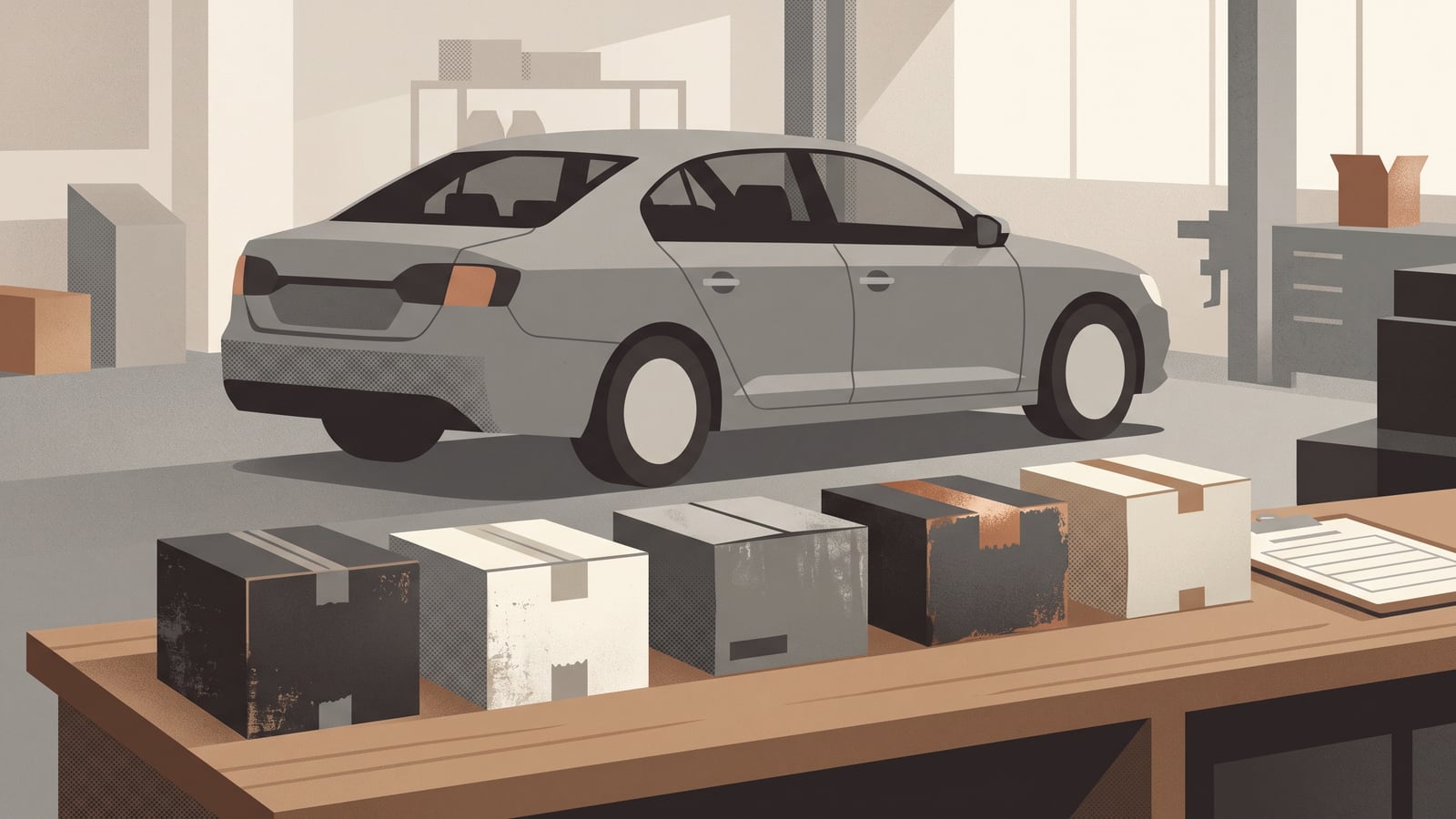
A workshop estimate might call a part OEM, OE, remanufactured, used, or aftermarket. That label is doing less work than it looks like it's doing. A label is a starting point for questions, not a verdict on the part. Terminology varies by source and market, so none of these five words by itself proves fitment, quality, warranty, safety, roadworthiness, service life, or value. What settles the choice is the identified part, its condition and supplier, what the specific repair requires, the warranty and repeat-labour terms, and the complete quoted repair.
This piece walks through the five labels, then looks at two ordinary repair situations to show how the tradeoffs play out, and ends with one compact list you can use to confirm what you're being quoted. It doesn't rank the categories against each other — the right answer depends on the part in front of you.
What the labels suggest
Here's what each label suggests, and the question it should make you ask next.
| Label | What it may indicate | Question that matters most |
|---|---|---|
| OEM | In the cited EU/EEA example, this means a part carrying the vehicle manufacturer's trademark. Everyday use on an estimate may be looser than that. | What brand, maker, and part number is on the invoice? |
| OE | A prompt to ask who made and distributes the part. The same EU/EEA example describes original parts and equipment as made to the carmaker's specifications and production standards for building that car. | Who made it, and to what spec was it built? |
| Remanufactured | Needs a process description behind it. The US federal procurement example (FAR Part 11) treats it as factory rebuilt to original specifications, though GAO's 2013 review of 14 selected US federal agencies found no single definition applied across the contexts it examined — and GAO said those observations weren't generalisable to every facility or commercial workshop. | What was replaced, restored, and tested, and what's the warranty on this specific unit? |
| Used | Prior use, nothing more assumed. It doesn't imply any defined rebuilding process. | What's its condition and provenance (where it came from and how it was handled), and what inspection, testing, or warranty comes with it? |
| Aftermarket | A broad category for parts sold outside carmaker branding — a supply route, not a quality tier. | Who makes it, what's the exact identifier, and what's the fitment basis (the evidence it's built to fit your specific car)? |
Two things hold true across every row. First, the EU/EEA and US federal procurement definitions above apply only within their own stated contexts — they aren't a single definition that holds everywhere, and your local terminology may differ. Second, a label does not by itself establish exact fitment — the actual maker, part number, condition, and warranty have to be confirmed for the specific item on your estimate.
Held up against real repair situations, here's roughly how the five tend to play out:
- OEM tends to help when the estimate already gives you a precise, carmaker-branded identifier and current instructions support that route — it's a weaker choice when all you have is the category name with nothing behind it.
- OE is worth pursuing when the producer, specification, and fitment basis are documented; a supplier logo on its own, without that documentation, tells you less than it looks like.
- Remanufactured can suit a repair where the rebuilding process, testing, warranty, and core-return terms are spelled out for the specific unit; it's a poor fit when the supplier won't say what was done or tested.
- Used can be reasonable when the donor part's identity, condition, and provenance are disclosed and the repair doesn't hinge on unknown remaining life; it's a poor fit when none of that is available.
- Aftermarket can work as another identifiable supply route once the maker, specification, and warranty are confirmed; leaning on the category name alone — especially for a safety-critical repair — is where it falls down.
How the options play out
Once you set the label aside, here's what the comparison runs on — the same handful of things whichever of the five you're looking at:
- the part's exact identity and fitment basis
- whether it's new or has seen prior use, and if it's been processed, what was done to it
- who supplies it and where it came from
- what's available and at what total quoted cost
- who stands behind it if it fails
- what happens to any refundable core charge
- for some repairs, which vehicle-specific procedure or local rule governs the work
None of this produces a scoring rule. It's a way of noticing which differences are worth asking about for the repair you're facing, and which are cosmetic.
Keeping an older car
Picture an owner planning to keep a twelve-year-old car for several more years. Three quotes come in: an identified OEM part, a documented OE-described part, and a remanufactured unit. For all three, the owner asks for the exact identifier and fitment basis before comparing anything else. For the remanufactured unit, that also means asking what work and testing it went through, and what the core-return terms are (a core charge is a deposit tied to returning the old, worn unit, and its refundability, amount, and deadline depend on the actual quote). It also means asking what the warranty excludes and who pays the labour again if it fails early.
The price on the estimate might make one option look obviously cheaper. But a lower number on the remanufactured line doesn't say how long it'll last, whether it's comparable to the other two, or what happens if it needs to come back out. If the remanufactured unit's process, testing, and warranty are documented and comparable to the OE-described part, and the core terms are acceptable, it can be a reasonable choice for an owner planning several more years with the car. If the supplier won't put any of that in writing, the remanufactured option stays unresolved rather than ruled out. The same test applies to the OEM and OE-described quotes: each has to be compared on its own exact identity, fitment basis, warranty, repeat-labour terms, and complete quote before it's the one the owner can stand behind.
Intended ownership length is a legitimate part of the conversation; it still can't substitute for the documentation.
When availability matters
Now picture a car that's off the road and needs a part soon. A used item and an aftermarket item are both available faster than an OEM-described alternative. Availability is a legitimate factor — every day the car sits is a day it isn't being driven. But it doesn't answer the other questions.
The used item still needs a donor identity, a condition description, whatever provenance is available, and disclosed testing or inspection before anyone can call it a reasonable fit. The aftermarket and OEM-described options still need exact identifiers, evidence they fit this car, warranty terms, and a complete installed quote that covers more than the parts price.
If the used or aftermarket item comes with that documentation and the repair isn't safety-critical, faster availability is a genuine reason to choose it over waiting for the OEM-described part. If the part sits anywhere near a safety-critical system, though, being available sooner doesn't mean it's approved for the job — that decision runs through current vehicle-specific manufacturer instructions and a qualified repairer.
Confirm the repair
Before you authorise anything, stick to owner-safe activity: read the estimate, write down identifiers and terms, ask the workshop direct questions, and check current sources. Don't diagnose or install anything yourself.
Ask the workshop to confirm, where applicable, for the actual quote:
- Identity and fitment. The maker, brand, exact part number, any supersession (a newer part number that replaced an older one), and the basis for saying it fits your car.
- Condition and processing. Whether it's new or has seen prior use, and if it's been processed, exactly what work and testing it received.
- Supplier, warranty, and returns. Who supplied it, where it came from if that's relevant, the warranty and its exclusions, who's responsible for labour if it has to come back out, and any refundable core deposit or return terms.
- The whole job. Beyond the parts line, this includes shipping and labour; diagnosis and consumables; and any coding, calibration, taxes, or fees that apply.
- Vehicle-specific and local rules. Which current procedure applies to your car, and any local safety, roadworthiness, inspection, insurance, consumer, warranty, or contractual requirement that governs the repair.
Getting answers to these five questions gives you a real conversation with the workshop. It doesn't certify the part or the vehicle — a completed checklist is information, not a guarantee, and anything left unanswered stays unknown rather than assumed favourable.
Compare the totals
Once you have answers, compare estimates line by line rather than by the headline total. Put together your own current quote — dated, in your local currency, using the labour rate the workshop charges — covering:
- the part
- shipping
- labour time multiplied by that rate
- diagnosis
- any coding or calibration
- consumables
- taxes or fees where they apply
If one quote includes a refundable core charge, keep it separate from the final cost: it's a deposit you may get back once the old part is returned.
Where a line item is missing from one quote, leave it as unknown rather than treating it as zero; an estimate that omits shipping or calibration isn't cheaper — it's incomplete.
Once you've lined everything up, the comparison shows you each currently quoted total for the documented scope. The final invoice can differ once work is under way and the scope changes. It doesn't tell you which part fits better, is safer, more reliable, or lasts longer. A lower quoted total doesn't establish suitability or represent the best value, and none of this can make an unsafe or unroadworthy car acceptable. It just tells you what each option costs as quoted today, for the work as described.
Who can confirm what
No single party can answer every question here, which is part of why the label alone isn't enough.
The EU/EEA and US federal procurement examples above are regional and procurement-specific; your local terminology may use these words differently.
On the US side, a 2001 US interpretation from NHTSA illustrates that regulatory treatment can depend on the component and governing provision involved — it isn't a full account of current US rules for every replacement part, just one dated example of how the treatment can vary by component.
In practice, four different parties can each confirm a different piece of the answer. Current vehicle-specific manufacturer instructions describe what a given repair on your vehicle requires. The identified supplier can confirm the part's specification, warranty, and commercial terms. The workshop or qualified service can state which part it's willing to fit, its proposed procedure, and how it verifies the finished job — what that verification covers varies by workshop. And the governing local authority can supply whatever inspection, roadworthiness, or consumer-protection rule applies where you live; insurance and contract terms come from the applicable policy or contract itself.
If you're supplying or sourcing a part yourself, ask the workshop upfront whether it will fit a part you provide, and agree who's responsible for labour, warranty, and returns if it turns out wrong — settle that before you buy it.
Safety-critical repairs
This matters most for brakes, steering, wheels and tyres, restraints, fuel systems, vehicle structure, stability systems, and high-voltage components. For those, current vehicle-specific manufacturer instructions and a qualified, vehicle-specific service govern what's acceptable and how it's fitted — more than any category label does.
If you're not sure whether a safety-critical system's condition or a proposed repair is appropriate for your car, don't use the part's label to decide whether it's safe to drive. Follow the manufacturer's current stop-driving guidance and get a qualified, vehicle-specific assessment instead.
Here's a concrete example of why that line matters. In 2019, FCA issued a bulletin setting out FCA's position for parts used in certain collision repairs on its own vehicles. That's FCA's stated position for its covered collision repairs — not a general ranking of OEM against aftermarket parts, and not evidence about ordinary mechanical repairs on other makes. If your car needs similar work, the question is which vehicle-specific procedures your manufacturer specifies for that repair — confirmed with the identified supplier of the proposed part, carried out by a workshop or qualified service that follows those procedures, and subject to whatever your governing local authority requires.
Where to go next
This article lives in the workshop-and-costs hub, alongside guidance on what a complete repair estimate should contain, how to compare two repair estimates, and when it's worth seeking a second opinion on a repair. For the broader picture of managing a car through its ownership years, the car ownership section covers maintenance planning, symptom triage, and workshop relationships more generally.
Your next step: ask the workshop to record the proposed part's maker, exact part number, any supersession, and the fitment basis for your car before you authorise it.