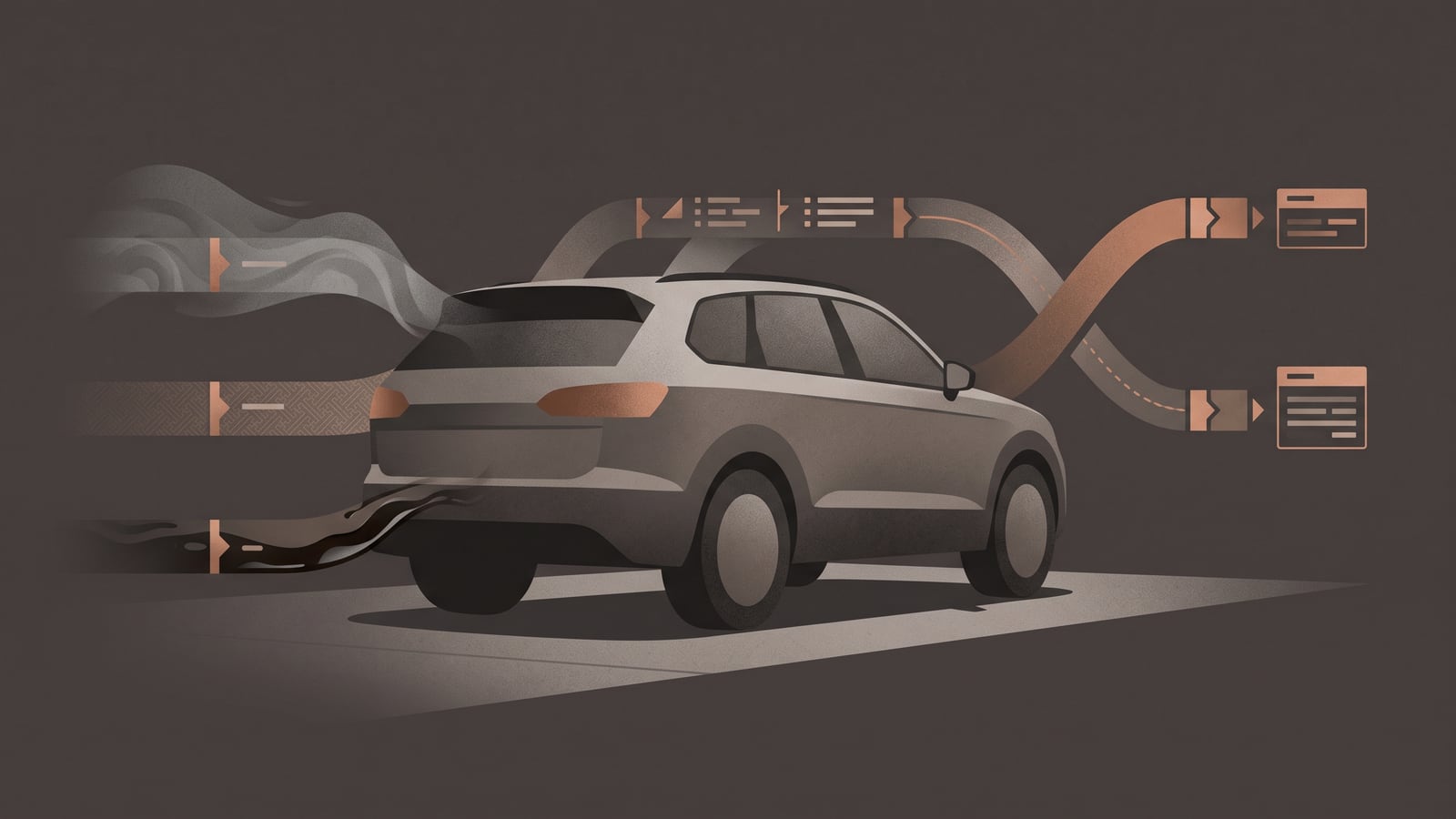
Smoke curling out from under the bonnet (hood), a strange smell in the cabin, a puddle you didn't put there — none of it tells you what's wrong. It tells you something changed. This guide walks you through checking for real danger first, then picking one of three next steps, and gives you a way to write down what you saw so whoever looks at the car next has something useful to go on.
Immediate danger
If you're driving when you notice any of this, the first move is the same regardless of what it turns out to be: pull over as safely and quickly as you can, switch off, and if anything suggests fire, get yourself and any passengers away from the vehicle before you do anything else — including reading the rest of this guide.
The first question isn't what this is — it's whether the vehicle is on fire, or close to it.
Treat any of the following as reason to suspect fire, even without visible flames: visible smoke or vapour coming from the engine bay or underneath the car, a strong fuel or petrol smell near a hot engine, heat you can feel through the floor, seat or dash, or a crackling or hissing sound from under the bonnet. This isn't an exhaustive list and it doesn't diagnose the cause — it's only enough to tell you when to stop reading and act.
If your vehicle is burning, or you reasonably suspect it is on fire, pull over as safely and quickly as you can, switch off once stopped, evacuate and do not return, do not attempt to fight the fire, and move at least 100 feet (about 30 metres) away and away from traffic before you contact local emergency services.
Two things worth adding. Don't open the hood or the trunk if fire may be underneath — feeding it air can make things worse. And once you're clear and safe, follow whatever the responders tell you to do.
That's the complete response for a burning car or one you genuinely suspect is on fire. It doesn't extend to every unexplained wisp of vapour or unfamiliar smell, which is what the rest of this guide is for.
Choose the next route
What you've noticed here is an observation, not a diagnosis: this guide cannot identify the fluid or fault behind it, and following these steps does not establish that the car is safe or roadworthy afterward.
Keep to that, and the routes below will do what they're meant to. From a safe distance, there are a few things to avoid:
- Don't touch or closely smell any liquid.
- Don't go under the car.
- Don't open a hood or trunk you suspect is over a fire.
- Don't work on anything hot or pressurised.
- Don't top up a fluid you can't identify.
- Don't attempt any fuel or high-voltage work yourself.
Those are jobs for later, best left to someone qualified.
Here are the three routes.
- Fire or immediate danger. If the vehicle is burning or you reasonably suspect it is on fire, follow the steps above: get clear and stay clear. If the car is an EV or hybrid, add the notification below too.
- Still active, but no fire. If you're still driving, pull over as safely and quickly as you can and switch off before anything else. If there's a live dashboard warning tied to what you noticed, or the smoke, smell or leak hasn't stopped, don't assume it's minor. Arrange a qualified assessment before deciding on further use when uncertainty remains, and check the exact current manual for your car's make, model, model year and powertrain for what that warning is telling you.
- Brief, stopped, or genuinely unclear. If what you saw was momentary, has stopped, or you're honestly not sure it means anything, start by recording the details below and checking the manual for that specific condition. If reading it doesn't resolve your uncertainty, that puts you back on Route 2: arrange the same qualified assessment before you assume normal use.
For Route 3, useful things to note from a safe distance:
- When you first noticed it, and how long it lasted.
- Where you were — moving, parked, just switched off, or being refuelled.
- Any dashboard warning light, symbol or message, copied exactly.
- What you can see from where you're standing — movement, whether it's continuing or has stopped.
- Anything that's changed about how the car normally runs or sounds.
Routes 2 and 3 are Autonelio's own way of framing a sensible response to uncertainty. They aren't a rule set from a regulator, a manufacturer, or a recovery service — where those bodies have their own requirements, those requirements take precedence.
Damaged or burning EVs and hybrids
This is based on January 2012 interim NHTSA owner guidance: after damage or fire, assume high-voltage components are energised, tell responders an electrified vehicle is involved, and have any damaged EV or hybrid looked at only by an authorised service centre or manufacturer representative, following current model-specific and local guidance.
If an EV or hybrid is on fire, leave immediately, avoid smoke and any gases coming off it, and wait safely upwind and uphill away from moving traffic, following responder directions. Don't attempt to touch exposed wiring or components on a damaged electric or hybrid car; that applies whether or not there's visible fire, because damage alone can leave high-voltage parts live.
Copyable handoff
Once you're safe and you've picked a route, a short written account helps whoever looks at the car next — a workshop, a recovery service, or an assessor. Copy the fields below and fill in what you know; "unknown" is a fine answer where it applies.
Vehicle handoff note
- Make, model, model year, powertrain: _____
- Location and traffic exposure: _____
- Operating state when noticed (moving / parked / just switched off / refuelling): _____
- Timing (when first noticed, how long observed): _____
- Dashboard wording or symbols (copied exactly, no interpretation): _____
- What was visible from a safe distance: _____
- Any change in normal operation: _____
- Recent refuelling or damage, if relevant: _____
- Actions already taken: _____
Here's what a filled-in version might look like, for a hypothetical case:
Powertrain: unknown. Operating state and timing: vapour first noticed shortly after stopping the car. Dashboard: warning text copied exactly, no interpretation. Visible observation: source not established from where the driver stood. Recent refuelling or damage: unknown. Action taken: vehicle not approached again.
Notice what that example doesn't do. It doesn't name a fluid, doesn't guess a fault, doesn't quote a manufacturer warning that wasn't displayed, and it doesn't say the car is fine to drive. It hands over facts, not conclusions.
Cabin fumes and garages
One sensory limit is worth knowing on its own: smell can't rule out carbon monoxide. It's colourless and odourless, it's produced by combustion, and even a small leak in the exhaust system can let it build up inside the cabin. If you notice fumes you can't account for, treat the uncertainty seriously rather than waiting for a smell that confirms it.
Never run a car or truck in an attached garage, even with the door open; detached garage guidance is separate, and there the advice is to open the door for fresh air. That instruction is specifically about running an engine in a garage. It doesn't stretch to cover an unfamiliar smell somewhere else.
Which instruction governs
A few different bodies have a say here, and it helps to know which one to lean on for which question. An incident itself is governed by local emergency services and responder instructions, roadworthiness by the relevant roadworthiness authority, and towing, storage or scrapping by a recovery or disposal provider where applicable. The fire, carbon-monoxide and electrified-vehicle guidance in this article comes from U.S. sources, so if you're elsewhere, your own local emergency number and local rules apply instead — and what a specific warning light or symbol means on your dashboard comes from your car's own current manual, for its exact make, model, model year and powertrain.
Where to go next
This article sits in the symptoms and diagnostics hub, which is the right place to keep exploring once you've settled the immediate safety question. From there, how to describe a car problem to a workshop builds directly on the handoff note above, preparing for a diagnostic appointment helps you get the most out of the qualified assessment this guide points toward, and warning light, fault code and diagnosis explains why a dashboard warning still isn't the same thing as knowing what's wrong. All of it fits within the wider car ownership section.
Your next step: From a safe position, decide whether there is fire or immediate danger; if there is, contact local emergency services and follow responder instructions. If there isn't, pick your route above and start filling in the vehicle handoff note — that's what turns what you noticed into something the next qualified person can use.