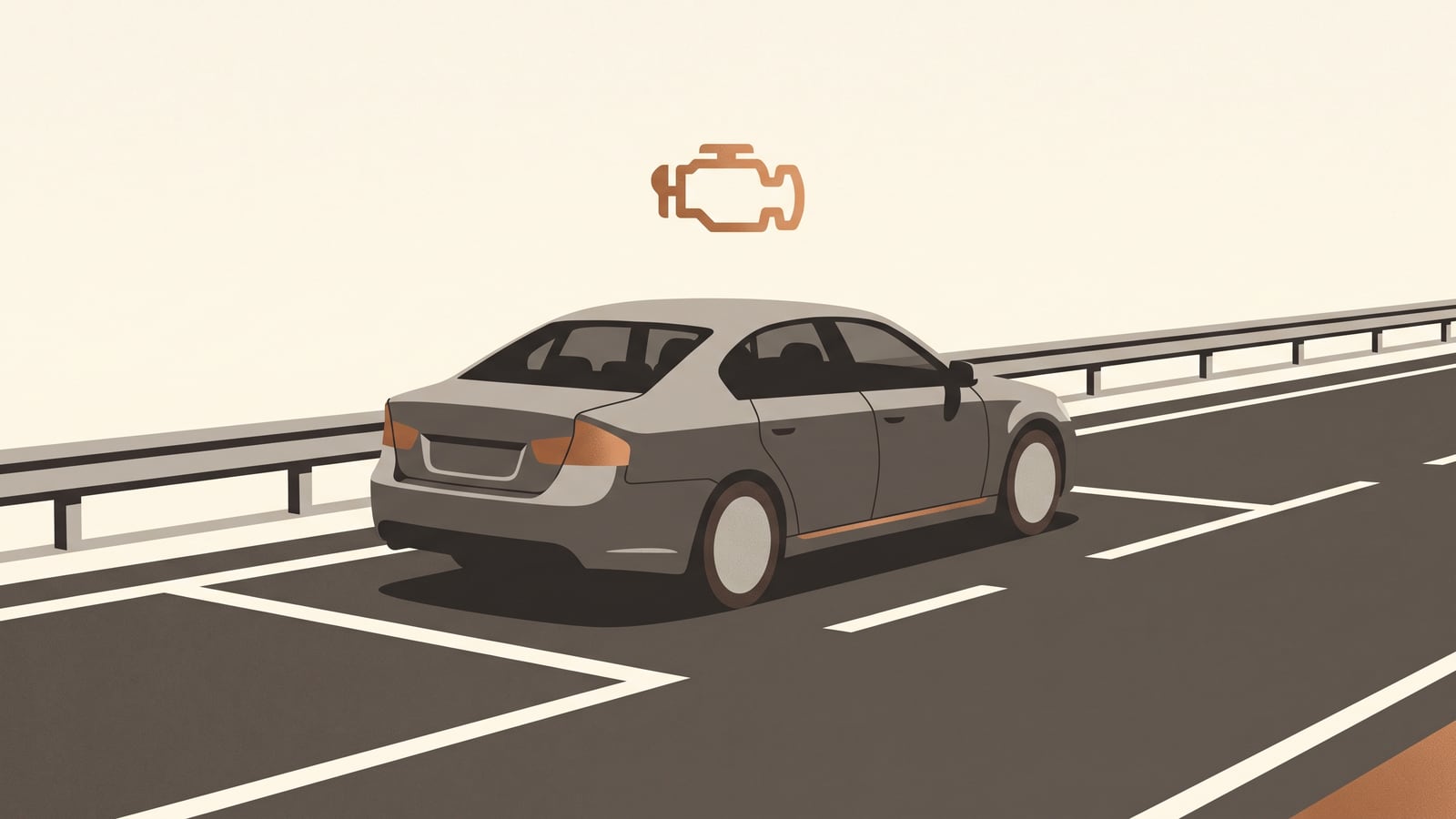
The engine hesitates, the pedal goes soft under your foot, and a warning symbol you don't recognize lights up the dash. Whatever's causing it, your first job isn't to figure out what's wrong. It's to keep the car under control and get it somewhere safe.
This guide walks through that first minute: the conditions that mean you should stop right away, what a reduced-performance mode is actually doing to your car, and how to write down what happened so a workshop can find the real cause instead of guessing.
When power drops in traffic
If acceleration suddenly weakens or the car won't respond the way it usually does, hold the wheel steady, ease off the accelerator, and work your way toward a safe place to stop, avoiding abrupt manoeuvres where circumstances allow and following your local emergency and roadside procedures. Exactly where and how you stop — which lane to move toward, whether to use a hard shoulder or a refuge area, how to signal you're there — depends on the road you're on and where in the world you're driving, so let local traffic and roadside safety rules and road markings guide the specific move.
As one labelled example, under UK Highway Code guidance for motorways and other high-speed roads, aim for a designated refuge area or the hard shoulder rather than a live lane; once you've stopped, get out on the side away from traffic if you can do so safely. If you're stranded in a live lane and can't exit safely, stay belted in and call 999 rather than stepping into moving traffic. Readers outside the UK should follow their own local traffic and roadside safety rules, since lane conventions and emergency procedures differ by country.
Once you're stopped somewhere secure, put the handbrake on. Only then start thinking about what happened. Diagnosis is a job for later — the first job is just getting off the road.
Warning lights and conditions that mean stop now
Some warnings and symptoms mean stopping as soon as it's safely possible and switching the engine off, whatever car you drive:
- Loss or reduction of braking, steering, or stability, or a warning lamp for any of those systems
- An oil-pressure, coolant-temperature or overheating, or charging warning that your manufacturer's instructions treat as a stop-driving condition
- Smoke, a burning or fuel smell, a significant fluid leak, or any sign of fire
- Severe abnormal noise or vibration
- Genuine uncertainty about whether a safety-critical system is working
- On a hybrid or electric vehicle: visible damage to high-voltage components, or signs of battery thermal trouble — stay away from the vehicle and get qualified help rather than inspecting it yourself
As one labelled illustration, the manual for a 2020 Ford F-150 Police treats a steady "Service Engine Soon" lamp as an emission-related fault detected by the onboard computer, and a flashing version of the same lamp as a possible sign of misfire severe enough to risk damaging the catalytic converter — in which case the manual says to avoid heavy acceleration and get the car serviced promptly. The same manual treats an oil-pressure warning while the engine is running, or a coolant-temperature warning while driving, as reasons to stop as soon as it's safe and switch off, and it describes a lit brake-system warning as a possible fault or low fluid level that can reduce braking performance and lengthen stopping distance. Your own dashboard and your current owner manual are what govern what your car's warnings mean — the F-150 details above show one manufacturer's approach, not a universal script.
A steady malfunction lamp or a general reduced-performance message on its own, without any of the conditions above, doesn't necessarily mean stopping immediately. But the safest move is still to reach a safe position, check exactly what the display is showing, and follow your current owner manual's instructions for that specific warning before deciding whether to continue.
What reduced-performance modes actually do
You've probably heard this called "limp mode." What's actually happening, on some vehicles, is that a manufacturer-defined limited state can be triggered by a relevant fault or an over-temperature condition. Exactly what that limited state looks like, and whether it still permits driving at reduced capability or none at all, depends entirely on the vehicle and what triggered it.
In manufacturer-specific systems such as Ford's fail-safe cooling strategy, an overheating condition can trigger a mode that limits engine power, may prevent the vehicle from maintaining higher speeds, and in a severe case can shut the engine down, with steering and braking becoming noticeably heavier once the engine stops assisting them; your vehicle's owner manual governs what your specific car does and what its warning symbols mean.
Worth keeping two possibilities apart. One is this kind of manufacturer-defined limited state — an electronic system holding back power for a reason specific to that vehicle and trigger, as in the Ford fail-safe cooling example above. The other is power loss that hasn't been established as a manufacturer-controlled limited state at all. Both can feel similar from the driver's seat: a car that suddenly won't accelerate the way it should. Only inspection can tell which one you're dealing with, which is exactly why the next section matters.
Why a fault code is not a diagnosis
Three separate things go on when a car's computer flags a problem, and mixing them up is where owners waste money.
The first is the warning light itself — a signal on the dashboard telling you a system has detected something abnormal. The second is the stored diagnostic trouble code, or DTC, that a scan tool can read from the car's computer. The third is a completed diagnosis: a technician's conclusion, backed by testing, about what's wrong.
A fault code is diagnostic evidence, not a diagnosis: it tells a qualified technician or diagnostic professional where to start testing, not which part has failed. Professional diagnostic practice uses that code as a starting point for circuit, sensor, and mechanical testing.
This matters because even if clearing the code makes the warning light disappear, that outcome doesn't establish that whatever triggered it has been repaired. It's best to leave the stored codes and any related information for the workshop to read before anything is cleared, rather than resetting the warning or disconnecting the battery yourself beforehand.
What to observe and record safely
Once you're parked safely and the engine is off if it needed to be, there's a short list of things you can check from outside a hot or pressurized system, without opening anything up.
- The exact warning message or symbol. Note its color, whether it's flashing or steady, and any text on the display. If you don't recognize the symbol, write down a plain description rather than guessing at what it means.
- Sounds. A new knocking, whining, hissing, or grinding noise, and roughly when it started relative to the power loss.
- Smells. Burning, fuel, or sweet coolant odors are all worth noting, along with roughly where they seemed to come from.
- Visible smoke or fluid. Look underneath and around the engine bay from a safe distance — don't open the bonnet if it's hot, and never open a pressurized cooling system. Note the fluid's color and roughly where it's pooling or dripping, if anything is visible.
- How the car behaved. Did acceleration feel limited at some point, did the transmission shift oddly or hold a gear, did the engine feel rough or lose power gradually rather than all at once?
None of this needs tools or getting under the car. It's observation from a safe position, aimed at giving a technician a clearer starting point.
Copyable workshop symptom record
Writing this down while it's fresh is worth more than trying to remember it later at the service desk. The template below covers what a technician typically needs; fill in what you can and leave the rest blank rather than guessing. Your current owner manual still governs what any specific symbol or restart behavior means for your car.
POWER-LOSS / REDUCED-PERFORMANCE SYMPTOM RECORD

Date and approximate time of event:
Vehicle: make / model / model year / powertrain (petrol, diesel, hybrid, electric):
Odometer reading (if safely accessible):

ONSET CONDITIONS
- Cold start or already driving:
- Road type and approximate speed (km/h, with mph if useful):
- Incline / load / towing:
- Weather and ambient temperature:
- Engine temperature gauge or other gauge readings, if visible:

WARNINGS SHOWN
- Symbol(s) or message(s) displayed (describe exactly, even if unfamiliar):
- Color and behavior (steady or flashing):

VEHICLE BEHAVIOR
- Acceleration restricted? How did it feel?
- Maximum speed reached, if response seemed limited:
- Transmission shifting oddly, or stuck in one gear?
- Engine roughness, vibration, or unusual gauge changes:
- Noises, smells, smoke, or visible fluid (describe and locate):

EVENT CONTINUITY
- Constant, or did it come and go?
- Any change after switching off and restarting?

ACTIONS TAKEN
- Where you stopped and how:
- Roadside assistance contacted? (yes/no, provider)

Do not infer: a warning light going off, a fault code clearing, or the car running
normally after a restart doesn't mean the fault is fixed. Write down what you
saw, not your read on whether it's resolved.
A worked example, entirely hypothetical, shows what a filled-in version might look like:
Date/time: Tuesday, roughly 5:40pm. Vehicle: a fictional "Corvel Halo" hatchback, model year 2015, diesel, around 158,000 km on the odometer. Onset: already driving on a dual carriageway at about 95 km/h (60 mph), mild incline, no trailer or load, dry evening, mild ambient temperature around 15°C, temperature gauge reading normal. Warnings: an amber engine-shaped symbol appeared, steady rather than flashing, with a message reading "Reduced Power" on the trip display. Behavior: the accelerator pedal felt like it had a ceiling — pressing further did nothing — and the car settled at around 65 km/h (40 mph) regardless of throttle input. No roughness or vibration noticed, no unusual noise, no smell, no visible smoke or fluid underneath when checked from outside after stopping. Continuity: the warning stayed on continuously; switching the engine off and back on at a service area made no difference to the symbol or the limited response. Actions taken: moved to a safe position off the live lane, used hazard lights, reached a service area, and called roadside assistance rather than continuing to drive.
Everything in that example is something the driver could observe directly — no part names guessed, no cause assumed.
What happens during a professional diagnosis
A workshop's diagnostic process typically starts with your symptom description, together with any stored codes and operating data the car's computer can supply, and continues with whatever circuit, sensor, and mechanical checks the specific symptoms call for. Which checks apply depends on the fault; a shop investigating a misfire looks in different places than one investigating an overheating symptom.
That investigation takes technician time, which is one reason a shop generally can't give you a firm repair price from a code alone over the phone — a code narrows where to look, not what the repair will cost. It's reasonable to ask your workshop how they charge for diagnostic time and how that fits into the eventual repair estimate.
Actions to avoid before your diagnostic visit
A handful of common owner reactions make the eventual diagnosis harder or riskier than it needs to be.
- Clearing the fault code yourself, or disconnecting the battery to make the warning light go away. As covered above, this doesn't fix anything, and it's best to leave the stored information for the technician to read first.
- Driving hard to see if you can reproduce the symptom. Deliberately pushing a car that's already flagged a protective mode or a serious warning risks turning a manageable fault into real mechanical damage.
- Ignoring a stop-now warning because the car "still seems to drive fine." Follow the displayed manufacturer instruction and stop for the observable safety-critical condition — reduced braking or steering, oil pressure, severe overheating, smoke or a burning smell, or a stability or safety-system warning — rather than relying on how the car currently feels to drive.
- Opening a hot or pressurized cooling system, or working underneath the car yourself. These carry burn and crush hazards and don't tell you anything a technician can't determine more safely with the right equipment.
Where to go next
This article sits in Autonelio's symptoms and diagnostics hub, alongside guides built for the same moment you're in right now. If what you actually saw was an overheating or coolant-loss warning rather than a general power-loss symptom, overheating warning or coolant loss covers that stop condition in more depth. The broader distinction this article leans on — that a warning light, a fault code, and a diagnosis are three different things — gets a fuller explanation in warning light, fault code, and diagnosis are not the same. And once you're ready to book the visit, how to prepare for a diagnostic appointment shows how to hand this kind of record over cleanly — part of the wider car ownership coverage this site builds toward.
Your next step: once you're stopped safely, open your vehicle's owner manual to the section on dashboard warning symbols and copy the exact wording or symbol you're seeing into the symptom record above.