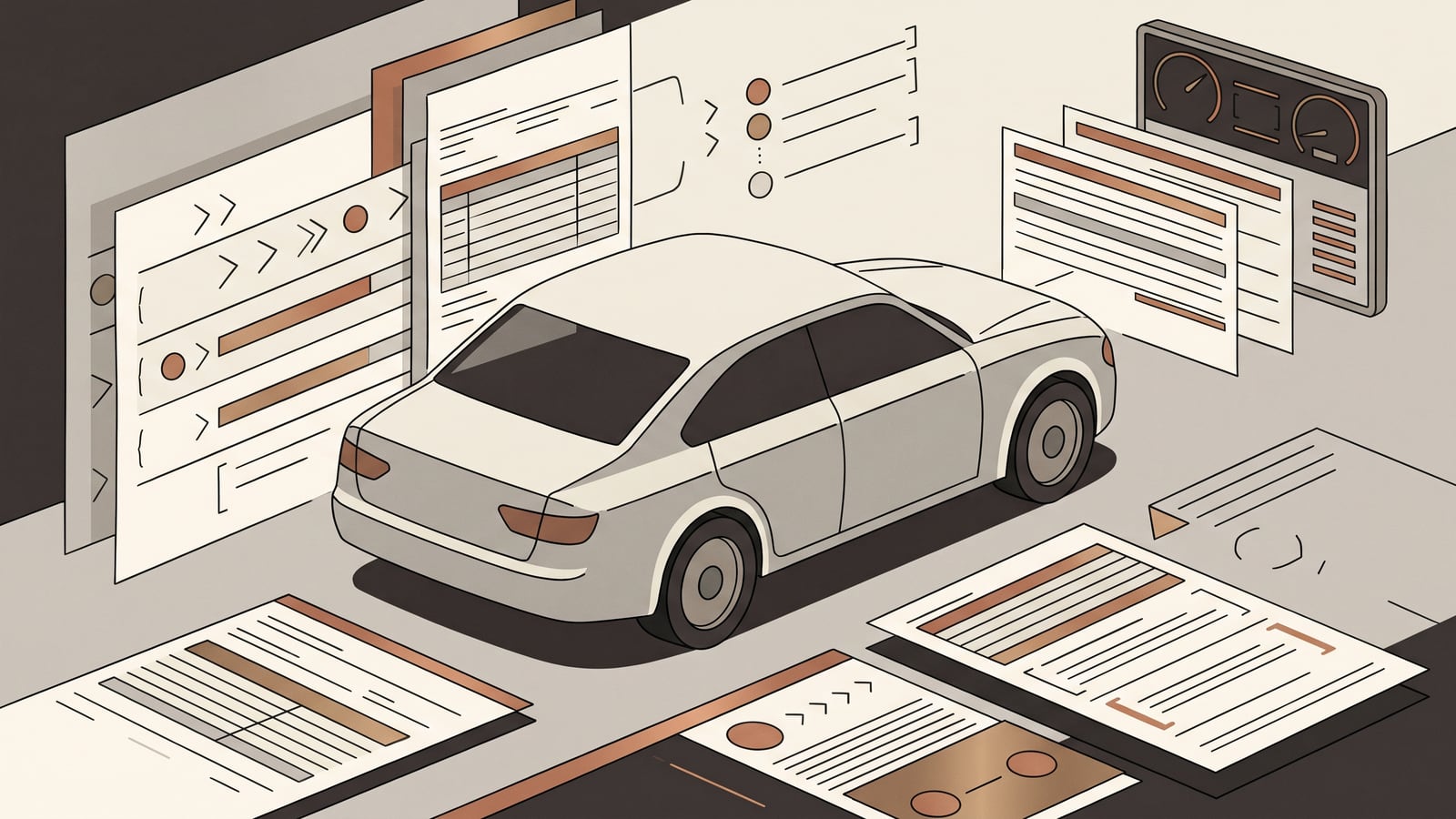
A diagnostic report gets a lot easier to read once you split it into two piles: what the shop found, and what they think it means. The first pile is evidence — codes, readings, anything someone saw, heard, or measured. The second is the technician's read on that evidence, plus whatever they're proposing to do about it. The two piles are related, yet distinct, and a report that blurs them together is much harder to act on.
That's the whole method here: read the report as a chain of reasoning you can follow from concern to conclusion. Something prompted the visit. The shop recorded some things. A technician connected those things to a conclusion. They recommended a next step. And somewhere in there, a few questions are probably still open. A code, a scan value, or a single test result is evidence. It does not by itself identify the root cause, prove a part has failed, or establish that a repair is required. Think of this as a framework for reading the document in front of you and landing on one useful question. It's not a way to diagnose your car, judge how urgent a warning light is, or rate the workshop.
Evidence first, diagnosis second
Start by noticing that a report can hold several different kinds of information, and they don't all carry the same weight. The EPA's inspected redline of the US emissions on-board-diagnostics rules — the agency's own memorandum says the Federal Register version controls if the two differ — treats stored fault codes, readiness status, the conditions recorded when a fault was flagged, and onboard self-test results as separate categories, within its own scope. That doesn't mean every report contains all four: this material covers US emissions-OBD specifically and doesn't extend to every diagnostic document a shop might hand you.
A manufacturer service document for one model makes the same point without over-generalizing: a stored code together with related engine data can help a technician narrow down where to look — that's the start of an investigation, and the investigation still has to happen before there's a diagnosis. That distinction matters for you as the reader. If the only thing on the page is a code, you're looking at retrieved data — someone still has to do the reasoning that turns it into an answer. Treat it that way: a code on its own does not by itself identify the root cause, and turning it straight into a part order skips the step where somebody worked out what's wrong.
The seven reading layers
Once you can tell evidence from interpretation, it helps to have a consistent way to sort what's on the page. What follows is an Autonelio reading framework — these are not mandatory report fields. Workshops write these documents differently, formats vary, and a short or informal report isn't automatically a bad one. Think of the seven layers below as questions you ask the page, rather than boxes it's obligated to check.
- Reported concern — what the owner, driver, or workshop said prompted the investigation.
- Vehicle context — the vehicle's identity and any stated conditions relevant to the concern.
- Observations and retrieved data — what was seen, heard, measured, or pulled from the car's systems, including any codes or scan output.
- Tests and results — any check the workshop ran, and what it produced.
- Technician conclusion — the explanation connecting the evidence to a suspected or confirmed problem.
- Recommendation — further investigation, monitoring, or proposed work.
- Unresolved questions — anything not yet tied together, or limits the workshop states about itself.
Not every report spells out all seven, and that's not automatically a red flag. What matters is whether you can follow the chain of reasoning where it exists, and see clearly where it doesn't.
Concern and vehicle context
The reported concern is what triggered the visit — a warning light, a noise, something the driver mentioned. It tells you which question the document is meant to investigate, which is worth comparing later against the stated conclusion. Vehicle context is whatever the report states about the car itself and the conditions around the concern — mileage, when the symptom shows up, and so on. There's no fixed list of context fields a report has to include. Note whatever the document gives you, and don't assume anything it doesn't.
Observations, codes, and scan data
Observations and retrieved data are what was directly seen, heard, measured, or pulled electronically — including fault codes and scan output. This is retrieved data: useful, but it does not by itself identify the root cause. The safest habit is to copy the report's exact wording for a named system or component, instead of writing it up as though the part had already failed. If the report says a sensor circuit is flagged, write down that the sensor circuit is flagged, and leave any claim that the sensor needs replacing to the technician's conclusion. If that translation happens, it's the technician's job, and it belongs in the conclusion layer.
Tests and recorded results
A test is different from an observation: it's something the shop deliberately ran, and the result is what it produced. Seeing a recorded test and its result helps trace the reasoning — you can follow which evidence the technician had in hand. But this article hasn't inspected your vehicle, and a written result on a page does not independently validate that the test was performed correctly, interpreted correctly, or that whatever it points to is actually the problem. A recorded result adds to the evidence pile without proving anything by itself.
Conclusion, recommendation, and open questions
The conclusion is the technician's stated explanation for how the evidence adds up to a suspected or confirmed problem. The recommendation is what they propose doing about it — more testing, monitoring, or a repair. And the unresolved questions are whatever's still open: a link between evidence and conclusion that isn't spelled out, a limit the shop states about its own findings, or something they say still needs confirming.
Keep the document's own uncertainty words intact. "Likely," "possible," and "requires further testing" are doing real work in a sentence, and rewriting them as certainty changes what the report is telling you. A recommendation appearing on the page doesn't by itself prove it's necessary. Recommendations range from precautionary monitoring to urgent work, and the report alone doesn't establish which. On the other hand, a shop that plainly states what it doesn't yet know isn't giving you a worse report — that stated uncertainty can tell you exactly what the next diagnostic step is meant to settle.
Three common report patterns
Three broad patterns are worth comparing here. None of them is inherently better than the others — the difference is how much of the reasoning chain you can see, and each one has situations where it's a poor fit.
| What the document exposes | Most useful follow-up question | What it cannot establish by itself | |
|---|---|---|---|
| Code-only printout | Retrieved identifiers or data, little else | What observation or test supports this? | A failed part or completed diagnosis |
| Report with recorded tests | An evidence trail linking checks to a result | Does the result connect to the recommendation? | That the test was run or interpreted correctly, or that repair is required |
| Conclusion-led with open questions | Stated reasoning and named uncertainty | What would resolve what's still open? | Diagnosis, safety, or roadworthiness |
The useful question across all three is the same one: can you see what was reported, what evidence backs it, and how the stated conclusion follows? That's a reading method for you as the reader. It isn't a workshop-accreditation test, and it isn't meant to rank one shop against another.
A code-only printout
Picture an owner whose dashboard warning comes and goes — there one morning, gone by afternoon. The shop hands over a printout with a single retrieved code and nothing else: no recorded test, no stated reasoning, no conclusion. That's fine for what it is. A code-only printout is good at preserving the exact retrieved identifier for discussion, and it can be a starting point for someone qualified to look further. What it tends to leave out is the operating context, any tests that were run, the reasoning, and the uncertainty — the parts that would tell you why the code showed up.
The owner's useful question isn't "which part do I need to buy?" It's "what observation or recorded test result supports the stated conclusion, and what remains unconfirmed?" A code-only sheet is a poor fit if what you need is to understand why a repair is being suggested, or if you're trying to decide whether to keep driving. That's a warning-response decision, and a printout alone doesn't answer it. For that decision, use the current manufacturer instructions that apply to your exact vehicle, and get qualified help if the instructions or situation call for it.
A report with tests and results
Now picture a second owner whose report includes a recorded test result and a repair recommendation — but the sentence connecting the two is missing. The evidence trail is more visible here than with a bare code list: you can see that something specific was checked and what it produced. That's the advantage. The limitation is that the document alone can't validate how the test was performed or interpreted, and a recorded result does not independently confirm that the repair is necessary, that the vehicle is safe, or that it's roadworthy.
The useful move for this owner is asking the shop to state the missing link — how the recorded result led to the recommendation — rather than assuming a test result on its own settles the matter.
A conclusion with questions still open
A third owner gets a report that names a likely cause and recommends further investigation rather than an immediate repair. At first glance, a terse code sheet can look more definite because it says less. But a conclusion-led report that plainly states what's uncertain, and what the next step is meant to resolve, can be more useful precisely because the uncertainty is visible instead of hidden. The tradeoff is that if the observations or test results behind that conclusion aren't recorded, the reasoning can still be hard to follow. Either way, a likely cause is not the same thing as a confirmed failed part, and rewriting it as one — whether the owner does it or this article does — would misrepresent what the shop said.
Copyable report-reading checklist
Use this to sort a report you're holding. Copy consequential wording exactly, including qualifiers like "possible," "intermittent," or "requires further testing" — don't paraphrase them into something more definite.
REPORTED CONCERN:
_________________________________________________

VEHICLE CONTEXT (as stated in the report):
_________________________________________________

OBSERVATIONS / CODES / RETRIEVED DATA (exact wording):
_________________________________________________

RECORDED TESTS AND RESULTS:
_________________________________________________

TECHNICIAN CONCLUSION (keep qualifiers intact):
_________________________________________________

RECOMMENDATION:
_________________________________________________

UNRESOLVED QUESTIONS:
_________________________________________________

Ask the workshop: "What observation or recorded test result
supports [stated conclusion], and what remains unconfirmed?"
That last line is a conversation aid, not a legal demand or technical challenge. Use it to ask what supports the conclusion and what remains unconfirmed; it does not instruct you to test the car yourself. The checklist organises a report you already have. It does not diagnose your vehicle, validate the shop's findings, or certify that the car is safe or roadworthy, and it doesn't replace instructions that apply to your specific vehicle.
Where the framework stops
Sorting a report into layers tells you what was recorded and how the reasoning connects — it doesn't tell you whether to keep driving, whether a repair is genuinely required, or whether the car meets any safety or roadworthiness standard. Those are decisions for current applicable manufacturer instructions for your exact vehicle, market, model year, and powertrain, and for qualified help where the instructions or the situation call for it. Where regional safety, inspection, or roadworthiness rules are involved, direct those questions to the applicable authority for regional rules in your area rather than to this article.
Manuals can also disagree with each other: a vehicle's supplied manual and its online version don't always match. When versions conflict, confirmation of the applicable version belongs with the manufacturer or qualified service — this framework cannot decide it for you.
Where to go next
This article sits in the symptoms-and-diagnostics hub, alongside pieces built for the steps around a report like this one. If you want to understand why a warning light, a fault code, and a diagnosis aren't interchangeable, read what each one can tell you. If you're heading into a workshop conversation, how to describe the problem clearly and how to prepare for the appointment itself both build on the same reading habits. For the wider set of ownership decisions this connects to, the car-ownership section is the place to browse from.
Your next step: take the report in front of you and mark each statement by which layer it belongs to. Find one place where the evidence doesn't clearly connect to the conclusion, then ask the shop: "What observation or recorded test result supports [stated conclusion], and what remains unconfirmed?"