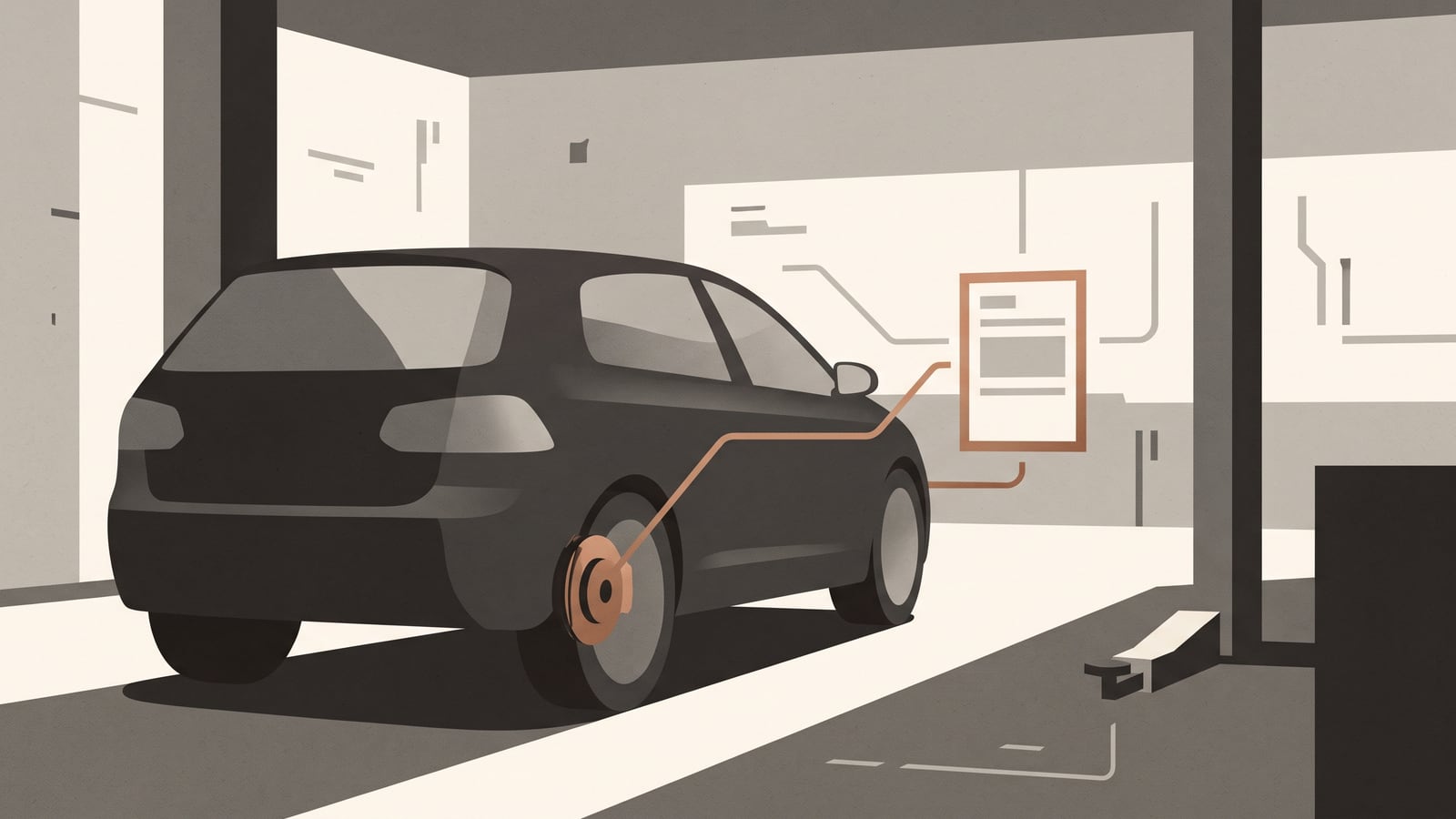
Keep the car still
Something's changed about how your brakes feel, sound, or work. A new scrape, a softer pedal, a pull to one side, a warning light you haven't seen before. The instinct is to drive around a bit and see if it happens again. Don't.
There's no single rule that covers every brake change you might notice — the evidence doesn't support one, and inventing one would be irresponsible. What does hold up is the pause itself: keep the car stationary, write down what you noticed, and find out what your car is telling you before you decide anything else. Check the current manual for the exact vehicle and market before you act on a warning, and let roadside assistance or a qualified workshop take it from there — do not drive merely to reproduce the concern.
It helps to be clear about what this article can and can't do for you. A noise, a soft pedal, a pull to one side, a new warning light — any of these is an observation. It isn't a diagnosis. It doesn't certify the car as safe or roadworthy, and it can't tell you a repair worked just because the symptom went away. Everything below helps you observe well and hand that off clearly — working out what's actually wrong is the workshop's job.
What to record
Once the car's stationary and you've decided not to chase the symptom on the road, write down what you noticed while it's still fresh.
One older GM dealership workflow uses a structured intake sheet to capture exactly this kind of driver-reported detail before a technician moves on to system checks. Treat what you write here as a record for handoff, not a test of your own: in that specified GM process, this information is preliminary input in the specified GM workflow that comes before the technician's system checks, root-cause work, repair, and verification, and it is not an owner diagnostic test. No single sequence like it applies to every brake-related fault code. Your job is to describe, not to conclude.
Describe the change
Use your own words. Nobody expects clinical precision here — just an accurate account of what you noticed, without a cause or urgency attached.
- Warning lamp or message — copy it exactly as it appeared on the dashboard or display, including any wording alongside a symbol.
- Noise — describe it the way you'd describe it to a friend (scraping, grinding, squealing) and note when it happened: cold start, low speed, hard stop, and so on.
- Pedal feel — did it travel further before the car responded, or feel softer or firmer than usual? Describe the sensation without guessing a cause.
- Vibration or pulsation — note where you felt it: through the pedal, the steering wheel, or the whole car.
- Pulling — which direction the car pulled while braking, and whether it happened every time or just once.
- Stopping behaviour — anything that felt different about how the car slowed or stopped, described from memory rather than something you went and reproduced.
- Context — when it started, how long it lasted, how often it's happened, the weather and road conditions, and anything you noticed that seemed to start or stop it.
Brake-change handoff record
The record below turns those observations into something you can read straight to roadside assistance or hand to a workshop. It captures what you noticed. It doesn't diagnose the fault, and it doesn't certify that the car is safe to drive or roadworthy — that judgment needs someone qualified looking at the actual vehicle.
If you didn't notice anything for a field, write "not observed" rather than leaving it blank or inferring an answer from a different field — a blank reads as an oversight, while an explicit "not observed" tells the workshop something real.
Blank record
- Immediate safety-screen outcome (car kept stationary / driven further, and why)
- Whether the vehicle was driven after the concern was noticed
- Date and time observed
- Continuous or intermittent occurrence
- Warning lamp or message, exact wording
- Noise, in your own words, and when it occurs
- Pedal travel or firmness — how it felt different
- Pulsation or vibration, and where felt
- Pulling, and direction, if observed
- Changed stopping behaviour, if observed
- Onset, duration, frequency, environment, and operating context
- Anything already observed to start or stop the concern
- Vehicle make, model, model year, powertrain, market, and VIN (vehicle identification number, which pins down the exact vehicle and its original market when documents disagree)
- Relevant wording from your current vehicle manual
- Roadside-assistance or workshop contacted, and outcome of that contact
A hypothetical completed portion, to show the level of detail that's useful:
Warning lamp: none observed. Noise: "new scraping sound when slowing in normal traffic," first noticed this morning at low speed. Pedal: "felt softer than before" over the last two days. Stopping behaviour: no clear change noticed. Vehicle: make, model, and market not yet confirmed — owner bought the car recently and hasn't located the manual. Manual instruction: pending.
In this hypothetical, the missing vehicle market and the absence of a warning message mean there isn't yet enough to know which manufacturer instruction governs. That's a normal, honest state for a record to be in. The right move is to note "clarification needed" and contact roadside assistance or a qualified workshop with what's already written down — not to guess at a rule from a different car, and not to drive around trying to make the noise happen again.
Use the exact manual
Warning lamps can look similar from one car to the next, but what they mean and what you should do about them are specific to the vehicle, its model year, and its market. Warning meanings and actions vary by manufacturer, model, and warning state, so the current instructions for the named vehicle and market — together with the warning's exact state and any accompanying message — are the governing starting point; check the current instructions for your exact vehicle before treating any example, including the ones below, as an answer for your own car. If the instruction or the warning itself is unclear, qualified assistance can help confirm it. The two examples below exist only to show why that gap matters.
Ford example
For the 2021 US-market Ford Mustang Mach-E, Ford's owner's manual gives different instructions depending on which lamp appears. If the brake warning lamp comes on, Ford says driving is dangerous, may significantly reduce braking performance, and the vehicle should be checked as soon as possible. If the anti-lock braking system (ABS) indicator — the system involved in preventing the wheels locking under hard braking — comes on while driving, Ford treats that as a malfunction; normal braking continues without the ABS function, and Ford directs owners to an authorised dealer. And if a separate brake indicator lights while the car is moving with the parking brake released, Ford lists two possible explanations — low brake-fluid level or a brake-system fault — without choosing between them, and again directs owners to an authorised dealer. That choice is for a technician to resolve, not something to guess at from the driver's seat. Ford also notes that lamps can vary by region, and treats the manual originally supplied with that specific vehicle as the primary source for it — not a manual downloaded for a different model year or market.
Volvo example
For the UK-market Volvo EX30 2026, Volvo's documentation describes a brake-system warning that calls for immediate action and contact with an authorised Volvo workshop, and separately describes an ABS warning meaning the friction brakes still function, but without the anti-lock function. Both of those statements belong to that named car and market: they describe what Volvo has decided those specific warnings mean on that specific vehicle, not what a similar-looking warning means on a different make or model.
A matching sound proves little
It's tempting, once you've noticed a noise, to search for it and see if someone else has described the same thing. Sometimes you'll find a manufacturer technical bulletin that seems to match. Treat that as a lead, not an answer.
One such bulletin from GM describes a narrowly defined front-brake squeal at low speed and light pedal application, on specified 2021–2022 Buick Encore GX and Chevrolet Trailblazer vehicles built before stated production breakpoints, and notes that some noises within that exact scope may be normal characteristics of those cars. That bulletin applies only to those specified vehicles and conditions — a matching sound from your own car does not establish applicability, and the document itself was written for professional technicians, not as reassurance or a procedure for an owner to follow. If your car sounds similar, it tells you your noise has good company. It doesn't tell you what's causing it.
Northern Ireland guidance
If you're in Northern Ireland, one piece of official guidance is worth knowing, alongside — not instead of — your own vehicle's instructions. This is Northern Ireland guidance from nidirect and applies within that jurisdiction; it is not a global rule or a universal vehicle instruction, but it's a useful public reference. nidirect advises that an abnormal warning display should prompt you to stop and investigate, because it may indicate a serious fault, and it advises contacting a garage or mechanic immediately if the vehicle pulls to one side while braking. It also says low brake fluid may lead to brake failure and a collision, and advises recognising a low-brake-fluid warning where fitted — mentioned here only as that stated risk, not as something to check or top up yourself.
Hand it over
Once your record is filled in as far as you can take it, read it out to roadside assistance or hand a copy to the workshop. What matters most in that handoff is that the exact warning wording and the symptom context you wrote down come through clearly, rather than getting lost in a verbal summary.
Which one to contact follows from what your record already shows, not from a guess at the cause. Call roadside assistance if the car needs to stay where it is, if you haven't yet established that it's safe to move, or if you need help brought to the vehicle's location. Contact a qualified workshop directly if what's needed is help reading the manual's wording, you're arranging a booked assessment, or safe transport to the workshop is already arranged. Not knowing which manual or market applies doesn't change that call — you decide whether the car stays or moves from the symptoms alone, conservatively, and ask whichever you contact to help establish which market's documentation applies.
This article can't tell you what any of that will cost, whether it's covered by breakdown or warranty cover, how quickly help will arrive, what the diagnosis will turn out to be, or whether the car will pass any particular safety check afterward. Those are all questions for the people looking at your car. And the boundary from earlier still holds: describing what happened is your job. Assessing the brakes — and any work under the car, on the wheels, with brake fluid, or around high-voltage components on some vehicles — is not.
Where to go next
This article covers one moment: a brake-related change you've just noticed, and the safe, bounded steps between noticing it and getting qualified help. For the wider picture of how a symptom becomes a diagnosis, start at the symptoms and diagnostics hub. From there, how to describe a car problem to a workshop walks through turning an observation into a clear report, and how to prepare for a diagnostic appointment covers what to bring and expect at the visit. Warning light, fault code, and diagnosis: what each one can tell you explains why none of those three is the same thing as an answer. All of it sits inside Autonelio's wider car-ownership coverage, for readers working through what a car needs beyond this one moment.
Your next step: open the current manual for the exact vehicle and market, then copy the displayed warning and its instruction into the brake-change handoff record.